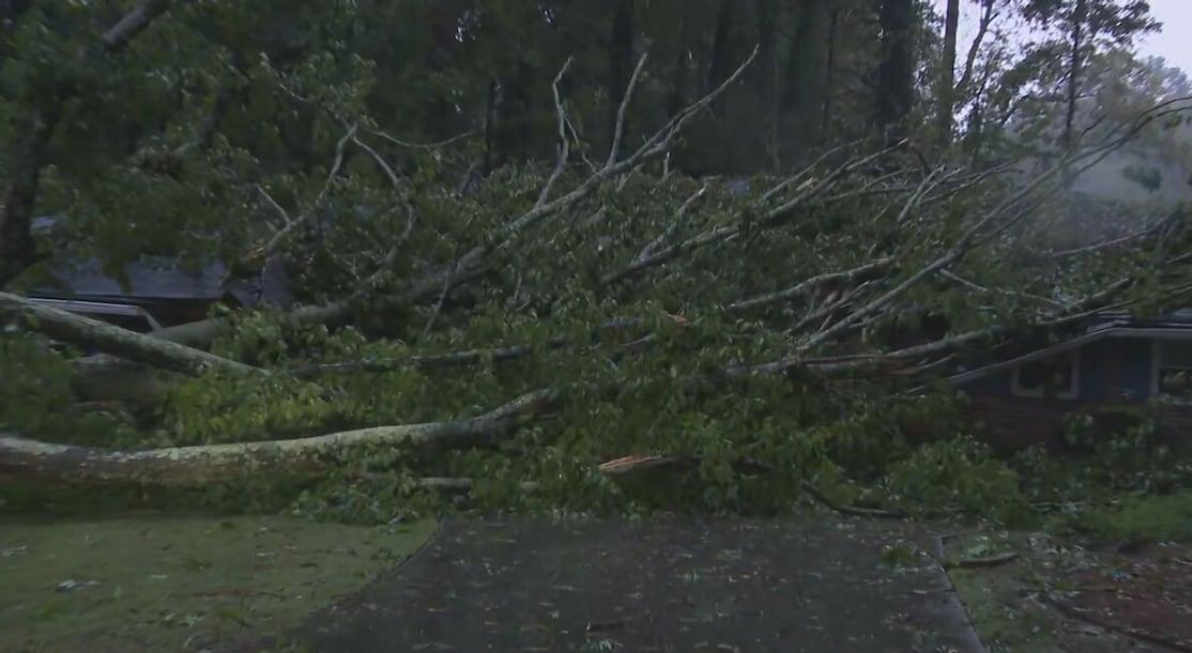

The remnants of Hurricane Isaias swept through Georgia over the weekend of October 9–11, 2026, bringing high winds, heavy rain, and downed trees that left tens of thousands of metro Atlanta residents without power.
What began as a Category 2 hurricane making landfall near Destin, Florida, late Friday night quickly weakened but still disrupted life across the region with gusty conditions, flooding risks, and extensive outages concentrated in the Atlanta area.
Isaias made landfall around 9:30 p.m. Friday, October 9, as a Category 2 storm with maximum sustained winds of about 105 mph. It rapidly transitioned into a post-tropical cyclone while moving inland over Alabama, with its center roughly 25 miles southwest of Montgomery early Saturday.
In Georgia, the system produced sustained wind gusts of 35–45 mph, with occasional peaks near 60 mph, alongside 2–4 inches of rain (locally up to 8 inches). A flood watch covered the state through Sunday morning, and the combination of saturated soil and wind toppled trees onto power lines and roads.
Power outages peaked above 120,000 customers statewide early Saturday, according to tracking services and utility reports. Georgia Power reported more than 60,000 customers without service early in the day, while Georgia’s electric membership cooperatives (EMCs) saw nearly 50,000 affected.
By around 2 p.m. Saturday, roughly 50,000 households statewide remained dark, with the bulk in metro Atlanta counties: approximately 4,300 in DeKalb, 2,500 in Gwinnett, 2,000 in Fulton, 600 in Cobb, and smaller numbers in Clayton and others.
Earlier peaks in core counties were even higher—Fulton alone reached over 13,000 at one point in the morning. Georgia Power alone saw outages climb past 80,000 at times before aggressive restoration efforts began.
The tree-heavy landscape of metro Atlanta amplified the problem. Residents reported sudden crashes as limbs and entire trunks fell on lines, homes, and vehicles. In places like Tucker, Highland Avenue, Cascade Road, Brookhaven, and Stone Mountain, crews cleared debris while repairing infrastructure. Cherokee County saw dozens of road closures from downed trees and lines, with some homes damaged. Flash flood warnings briefly covered parts of Fulton, DeKalb, and surrounding counties amid heavy downpours.
Beyond power, the storm caused secondary disruptions. About 40 flights were canceled and 140 delayed at Hartsfield-Jackson Atlanta International Airport. Roadwork, school activities, and local events were postponed or canceled. A high wind warning and flood watch remained in effect for North and Central Georgia into Sunday morning.
State and federal response was swift. Gov. Brian Kemp had issued a state of emergency on Thursday, authorizing National Guard support and other resources; it remained in effect through mid-October. On Saturday, President Donald Trump approved a federal emergency declaration covering 76 Georgia counties (including Fulton, DeKalb, Cobb, Gwinnett, Cherokee, Henry, and others), enabling FEMA coordination for recovery. Utility crews, drawing on lessons from prior storms like Helene and smart-grid technology, restored service to more than 80,000–100,000 customers by Saturday evening.
Statewide totals fell to roughly 9,000–20,000 by late Saturday/early Sunday, with metro Atlanta seeing sharp drops (Fulton under 800, DeKalb around 400, Gwinnett near 50 in some evening reports). Remaining outages were concentrated more in North Georgia mountain areas served by cooperatives such as Amicalola EMC.
By Sunday, October 11, severe weather threats were winding down, with improving conditions and a sunny, warmer outlook for the week ahead. Cleanup continued in neighborhoods where trees damaged property, and utilities emphasized prioritization of critical infrastructure followed by broad restoration. No major injuries were widely reported in the metro Atlanta area from the storm’s local effects, though the system caused at least four deaths farther south in Florida and Alabama, primarily from falling trees.
Isaias underscored the vulnerability of inland communities to the residual winds and rain of a weakening tropical system, particularly where mature trees and wet ground combine. As recovery progresses, residents were advised to report outages through utility apps and maps, avoid downed lines, and monitor local forecasts. Full restoration timelines vary by location, with urban areas recovering faster than more rural or mountainous zones