-
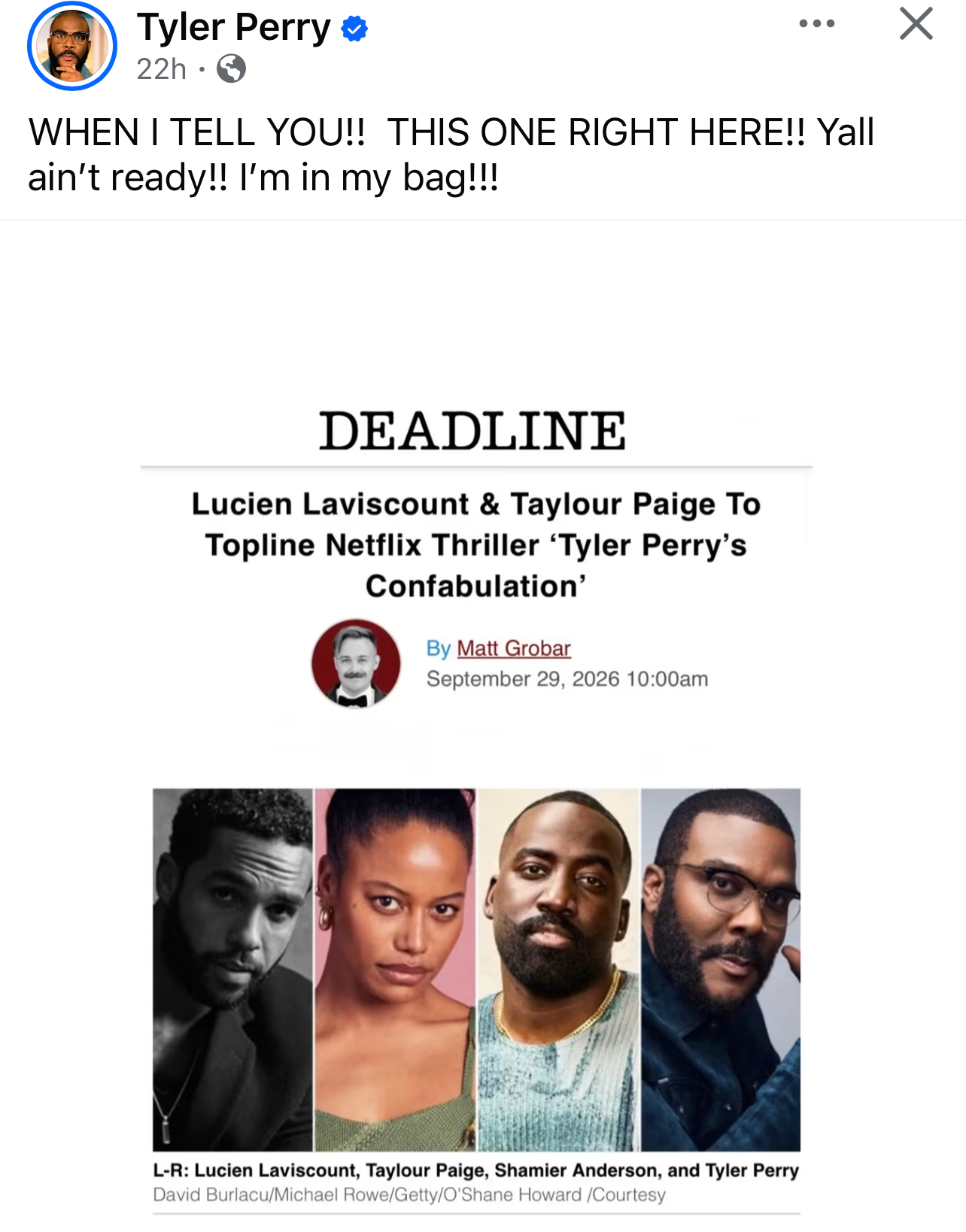
Tyler Perry is not easing off the gas. Details are emerging on the cast of his next Netflix thriller.
The project is Tyler Perry’s Confabulation, a psychological thriller written and directed by Perry for Netflix. Lucien Laviscount (Emily in Paris) and Taylour Paige (I Love Boosters, Zola) will star, with Shamier Anderson (John Wick: Chapter 4) in a key supporting role.
Tyler Perry Producing Netflix Thriller ‘Confabulation’
The filmmaker posted a blunt warning of his own: “WHEN I TELL YOU!! THIS ONE RIGHT HERE!! Yall ain’t ready!! I’m in my bag!!!”
The story follows a firefighter haunted by his past and struggling to tell memory from invention. He risks everything to pull his high school sweetheart away from her powerful husband. Then the ground shifts. What looks like a rescue may be something else entirely, and the film’s title is the clue: a confabulation is a memory that feels true even when it isn’t. Netflix’s own logline puts it more sharply: as he digs into her marriage, his fractured memories collide with the present, and he has to face the possibility that the mission he is betting his life on is not what it seems.
The supporting cast is stacked with Perry regulars and rising names: Nadine Ellis, Peter Parros, Najah Bradley, Mikeal Dwayne Griggs, Jenna Nolen, Michelle Núñez, Colin McCalla, and Shelley Robertson. Perry is producing with Angi Bones and Tony L. Strickland.
The pairing is a smart stretch for both leads. Laviscount has spent years as the charming Alfie on Emily in Paris and recently headlined Netflix’s People We Meet on Vacation. Paige has the sharper, more unpredictable edge, from Ma Rainey’s Black Bottom and Beverly Hills Cop: Axel F to Boots Riley’s I Love Boosters. Anderson, last seen as the Tracker in John Wick: Chapter 4, brings physical presence and ambiguity. Laviscount marked the news by calling the project unlike anything he has done and saying he was “sharing the dance floor” with Paige and Anderson.
This is the latest chapter in Perry’s long Netflix partnership, under which he writes, directs, and produces films and series for the streamer. His tenth Netflix film, Why Did I Get Married Again, just hit No. 1 on the Global Top 10 Movies (English) list. Doing Life arrives October 2.
The faith-based Give Me Some Sugah, produced with DeVon Franklin, is dated for December. A firefighter drama series, Where There’s Smoke, is also in the pipeline. Confabulation sits in that same run of work: high-concept, twist-driven, and built for the algorithm as much as for the living room.
No release date has been set. That is typical for Perry’s Netflix slate; the films often appear when he is ready, not when a calendar demands it. What is already clear is the bet.
Perry is using a medical term for false memory as the engine of a rescue story, and he is putting two actors known for charm and volatility at the center of it. If the post is any indication, he thinks the twist will land. Audiences will find out whether the bag he is in is as deep as he claims.
oming 2 America is just one of many films filmed in Atlanta. See our Movies Page for more.
Are you interested in becoming an actorin Atlanta? You’re in the right place!
With more than 900 movie and TV projects just in the last few years, the film industry has generated more than $9 billion for the state of Georgia.
There are so many movies filmed in Atlanta these days that it’s hard to keep up with it all. That’s why I suggest you subscribe to AtlantaFi.com to get all the freshest movie casting calls, celeb sightings and Atlanta happenings delivered to your inbox.
See Atlanta Casting Calls And Auditions Available Right Now
Want to work in Georgia film & TV? Here are the latest Atlanta casting calls
Read More From AtlantaFi.com:
-

Georgia Gov. Brian Kemp has suspended the state’s motor fuel excise tax for 30 days, starting at 12:01 a.m. on September 29, 2026, and running through October 29.
The move comes as gasoline and diesel prices remain elevated amid the ongoing U.S. conflict with Iran and related global market volatility.
Georgia Gas Tax Suspended: What To Know
Kemp issued an executive order declaring a state of emergency over petroleum supply disruptions and unpredictable price shocks. The order pauses the 33.3-cents-per-gallon tax on gasoline and the 37.3-cents-per-gallon tax on diesel (and certain other motor fuels). Officials expect the break to cost the state roughly $200 million a month in lost revenue, which is expected to be covered from Georgia’s surplus.
Statewide averages stood at about $4.19 per gallon for regular gasoline and $6.24 per gallon for diesel at the time of the announcement—still below some national figures but far higher than a year earlier. Because the excise tax is collected at the distributor level rather than at the pump, motorists may not see the full savings reflected immediately; prices typically adjust as new fuel shipments arrive.
The order also temporarily lifts certain state weight limits on commercial trucks (excluding interstates and posted bridge limits, and requiring permits). Officials say this could reduce the number of trips needed to move goods and help ease costs for groceries and other consumer products. Price-gouging protections on fuel and related emergency goods are included as well.
Kemp framed the action as part of a pattern of tax relief. “Over the past several years, with the help of our partners in the General Assembly, we’ve been able to give billions of dollars in relief to hardworking Georgians,” he said. “We’ve remained committed to helping them and our small businesses fight through the tough times, and that’s why I’m taking this action today to give further relief.”
Agriculture Commissioner Tyler Harper and other state leaders highlighted particular pressure on farmers facing high diesel costs.
This is not Georgia’s first fuel-tax holiday under Kemp. Similar pauses occurred in 2022 after Russia’s invasion of Ukraine, in 2023 amid high inflation, in 2024 after Hurricane Helene, and earlier in 2026 after the start of the Iran conflict (initially 60 days, with a later short extension). Earlier 2026 data showed the tax holiday lowered pump prices but did not fully offset broader market increases. Local sales taxes on fuel remain in effect.
The timing coincides with political pressure ahead of November elections, as household budgets feel the strain of higher energy and goods prices. Whether the 30-day window is extended will depend on oil markets and any further emergency declaration. Drivers should watch station prices over the coming days rather than expecting an instant, uniform drop equal to the full tax amount.
Atlanta’s retail scene continues to be a bright spot for the local economy — and that means more sales for everyone!
Here are more articles from AtlantaFi.com you might like:
-

Atlanta City FC is Atlanta’s incoming National Women’s Soccer League expansion club, set to begin play in 2028. It is owned by Arthur M. Blank through AMB Sports and Entertainment, the same group that operates the Atlanta Falcons and Atlanta United FC. The franchise was awarded in November 2025 for a then-record $165 million expansion fee and will share Mercedes-Benz Stadium with Atlanta United, using a lower-bowl configuration of about 28,000 seats.
Atlanta City FC: What To Know
The name, crest, and colors were unveiled on September 28, 2026, after a months-long process that included fan and community input. A public launch party is scheduled for October 4.
Brand and identity
The club’s official identity centers on Atlanta’s history of resilience and community. The circular crest features a phoenix—the city’s longtime symbol of rising after the Civil War—with an “A” formed in the bird’s shape. It is surrounded by a four-petaled dogwood blossom (representing unity and community) and grounded by roots (honoring history and foundations).
Primary colors are Atlanta Red (a lighter shade than those used by the Falcons and Atlanta United, creating a family connection without identical branding), Georgia Peach, Platinum Metallic, and Black Char. Officials described the palette as linking the team to the city’s sports heritage, hospitality, business and cultural leadership, and perseverance. The short wordmark is “ATL CTY.” The club has said it will not use “ACFC” to avoid overlapping Angel City FC’s branding.
Chief Business Officer Deandra Duggans emphasized that the name and look were chosen to stand independently from Atlanta United while still belonging to the same city and ownership family. “We wanted to make sure that this club stood independent,” she said. Arthur Blank framed the project as a club “built for the entire city.”
Facilities and operations
Home matches will be at Mercedes-Benz Stadium. Training and headquarters will be at a dedicated complex on a 33-acre site at 1033 Franklin Gateway in Marietta, near Atlanta United’s Children’s Healthcare of Atlanta Training Ground. Plans include an approximately 38,000-square-foot building, four full-size fields, and two half-pitches. The project, valued at more than $100 million, broke ground in April 2026 and is part of a larger AMBSE investment along the Franklin Gateway corridor. Completion is targeted before the 2028 season.
Aflac was announced in early 2026 as a front-of-kit sponsor in a multi-year deal described as one of the larger jersey partnerships in women’s sports. Leadership appointments have included Duggans as chief business officer and Keith McCloat as CFO.
Context in Atlanta soccer
Atlanta has been a strong soccer market since Atlanta United’s 2017 MLS debut, which produced rapid on-field success, record attendances, and an MLS Cup in 2018. The city is also home to the Arthur M. Blank U.S. Soccer National Training Center. Adding an NWSL club in 2028—alongside another expansion team in Columbus that will bring the league to 18 teams—extends that investment into the women’s professional game.
A separate amateur/semi-pro side also using the Atlanta City FC name has competed in the UPSL Georgia Premier Division. That club is distinct from the NWSL franchise.
The professional Atlanta City FC is still more than a year from its first roster and match. Its early public work has focused on brand, facilities, founding-member deposits, and positioning itself as a city-wide club rather than an extension of the existing men’s team. Whether that approach translates into on-field competitiveness and sustained local support will be the story of 2028 and beyond.
-

BARA, a Trinidadian restaurant specializing in bold island flavors, soft-launched its brick-and-mortar location in Atlanta on September 10, 2026.
Located at 999 Chattahoochee Avenue NW in Atlanta’s Westside (the same address previously associated with the Caribbean restaurant Negril), BARA marks a new permanent home for the concept after building a following through its food truck and appearances at Smorgasburg Atlanta.
BARA Opens in Atlanta
The soft launch event ran from 4 p.m. to 9 p.m., featuring Trinidad & Tobago cuisine, community vibes, and music by DJ Zess DJ TNT. The restaurant’s tagline captures its spirit: “Bold Flavors. Island Vibes.”
From Food Truck to Permanent Spot
Siblings and co-founders Malissa Browne and Peter Best bring more than 20 years of experience in Atlanta’s Caribbean dining scene. They previously worked with Negril (including its food truck and catering operations, plus sister locations in Brooklyn) before launching Bara ATL as a food truck focused specifically on Trinidadian cuisine in 2025.
While many local Caribbean spots emphasize Jamaican fare, Browne and Best set out to highlight Trinidad & Tobago specialties. Browne has noted that the foods share similarities with other Caribbean traditions but feature distinct standouts. The name “BARA” nods to the fried flatbread central to one of Trinidad’s most iconic street foods. The concept gained visibility as a vendor at Smorgasburg Atlanta, the weekly open-air food festival, where it offered items like doubles, roti, oxtail bowls, and later Bake & Shark.
The Menu and Experience
BARA serves vibrant Trinidadian street-food-inspired dishes and Caribbean comfort fare made with island spices. Signature offerings include:
- Doubles — a popular vegan street food of two soft fried bara flatbreads filled with curried chickpeas (channa), typically topped with tamarind sauce, chutney, homemade pepper sauce, and sometimes mango slaw or cucumber.
- Roti.
- Bake & Shark — crispy fried fish with fresh bake (fried bread) and island fixings.
- Oxtail bowls and other hearty, spiced preparations.
The restaurant emphasizes authentic flavors, good food, good people, and lively energy. It offers catering and has posted hours that generally run Tuesday–Thursday and Sunday 11 a.m.–8 p.m., and Friday–Saturday 11 a.m.–10 p.m. (closed Mondays; confirm current times). Early Yelp listings show a perfect 5.0 rating based on limited initial reviews for the Trinidadian concept.
A New Chapter for Atlanta’s Caribbean Scene
The move to a fixed location at 999 Chattahoochee Avenue NW represents growth from pop-ups and markets into a dedicated home. It expands options for authentic Trinidadian cuisine in a city with a strong and diverse Caribbean food presence. The soft launch invited the community to experience the flavors and atmosphere as BARA settled into its new space.
Diners interested in trying BARA can visit 999 Chattahoochee Avenue NW, Atlanta, GA 30318. Follow @baraatlanta on Instagram for the latest on hours, specials, and events. The opening adds another distinctive cultural voice to Atlanta’s evolving restaurant landscape, bringing the bold tastes of Trinidad & Tobago to the Westside.
If you like barbecue, see our list of the Best Atlanta BBQ Restaurants.
As for eateries below I-20, these Southside Atlanta restaurants have developed quite a following.
More Food Coverage:
Here Are The Best New Restaurants In Atlanta
-
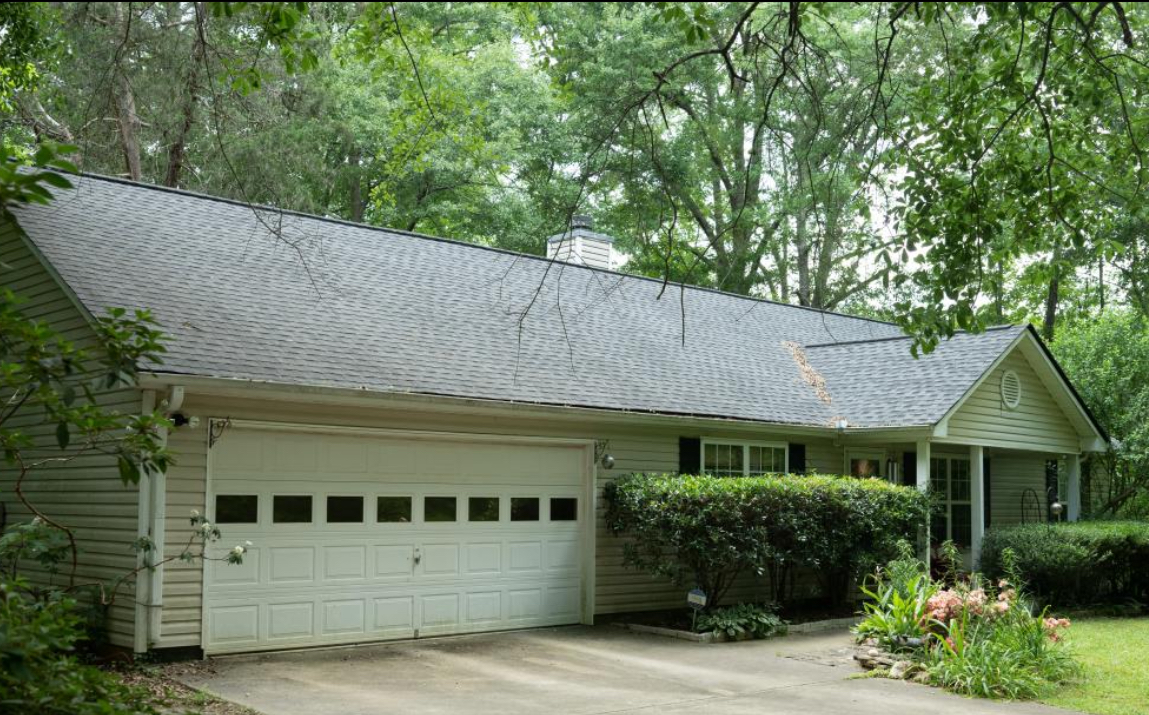
On Saturday, Ansley Brown stood in the driveway of her childhood home in Newnan, a U-Haul parked behind her, and recorded a farewell. “Today is the day we say goodbye to my childhood home,” she wrote. “Soon to be demolished by Georgia Power for the data centers.”
The video spread quickly. Within hours it had tens of thousands of views; by Sunday it was well past 170,000, with thousands of likes and a comment from former Rep. Marjorie Taylor Greene thanking her for fighting for her mother and her community.
Georgia Woman: My Home To Be Demolished for Data Centers
We interviewed a woman who says she doesn’t mind data centers. “As long as the local city and county get something out of the deal, I think it could be a win,” says John Preston of Sharpsburg.
When it comes to Brown’s home, she disagrees.
The house itself is modest: a pale ranch under trees, bought in 2003 by Brown’s mother, Angela Hall, with a USDA loan meant for single mothers in rural areas. Brown has said the place shaped who she is. Georgia Power is taking it anyway, not for a data-center building but for the right-of-way of a 35-mile, 500-kilovolt transmission corridor known as the Ashley Park–Wansley line.
The corridor cuts through Coweta and Fayette counties and is designed to move power from the revived Plant Wansley complex toward the Atlanta suburbs and a cluster of large computing campuses. About 330 properties sit on the route. Between 20 and 30 houses are expected to be demolished. Hundreds more will get permanent easements that put high-voltage towers close to bedrooms and backyards.
After months of negotiation, public videos, and pressure from lawmakers, Hall secured a price Brown’s supporters describe as $205,000 above her own appraisal and $275,000 above a Zillow estimate. Georgia Power says it negotiated in good faith, that eminent domain is a last resort used in less than 1 percent of its land deals, and that the line serves broader load growth—manufacturing and households as well as data centers—not a single customer. Brown’s reply has been consistent: the line exists because Georgia Power is recruiting data-center load, and her county did not vote for this trade.
That argument is no longer confined to one driveway. Georgia has become one of the country’s fastest-growing data-center markets and, at the same time, one of the loudest centers of opposition. Cheap land, available transmission, and a generous sales-tax exemption pulled in Meta, Amazon, Microsoft/QTS, Google, OpenAI, and a long list of smaller developers.
The exemption’s cost to the state ballooned from roughly $10 million in 2020 toward hundreds of millions a year; one audit put the figure near $625 million in a coming fiscal year and found that most of the construction would likely have happened without the break. Georgia Power has planned roughly 10 gigawatts of new generation and billions in grid work, with company and regulatory documents indicating that the large majority of that new power is expected to serve data centers.
Residents’ objections cluster around four things: water, electricity, land, and process.
In Newton, Morgan, and Walton counties, families living across the road from Meta’s Stanton Springs campus have shown jars of brown, silty well water and sued, saying blasting and excavation wrecked a shared aquifer. Meta commissioned a study that found no adverse effect; the families say they now buy bottled water and watch property values fall. Similar well and pressure complaints have surfaced near other sites.
Data centers’ cooling demand varies by design—some use closed loops and far less water than early estimates—but construction itself has already become a flashpoint.
Power is the second fight. Opponents fear residential rates will absorb the cost of new gas plants and transmission even when contracts say large customers pay their share. Supporters and the utility point to Public Service Commission language meant to keep existing residential rates from subsidizing new commercial load, and to the tax base and construction jobs that campuses bring.
The politics have already shifted: discontent over rates and data centers helped Democrats win two Public Service Commission seats, and the issue is now a regular feature of local and statewide campaigns.
Land use is the third. Coweta County’s Project Sail—an 829-acre, nine-building, roughly 900-megawatt campus on land that had been zoned rural conservation—became a statewide symbol. Neighbors organized, sued over the rezoning, and gathered a reported 14,000 petition signatures in an effort to force a home-rule referendum. Commissioners later unanimously denied a separate project, Project Oak.
Similar fights have broken out in DeKalb, Coweta, Effingham, Muscogee, Troup, Lowndes, Bartow, and a dozen other places. By mid-2026, dozens of cities and counties had passed or extended moratoriums or written new ordinances with setbacks, generator rules, and sewer requirements. Atlanta, Palmetto, and Fayetteville have effectively barred new facilities.
Process is what turned many of those fights bitter. Recruitment often happened under nondisclosure agreements. Local officials sometimes learned details only after deals were effectively done.
In Effingham County, OpenAI’s Project Camellia—a $20 billion, 4-million-square-foot campus projected at 3.2 gigawatts, larger than all the Atlanta-area projects then under construction combined—was announced after months of closed talks. Crowds of nearly a thousand packed an open house. Sen. Raphael Warnock showed up. The Southern Environmental Law Center sued, arguing sunshine-law violations.
A development-authority member was quoted saying that if the public had been asked first, they would have said no. OpenAI and local officials have pointed to existing industrial zoning, community-investment pledges, and a closed-loop cooling design. The lawsuit is the latest, not the first.
The pattern is now national, but Georgia is a concentrated case. A 2025 report found opposition blocking or delaying tens of billions of dollars in projects in a single quarter, with Georgia and Indiana leading the wave. The resistance is not neatly partisan. Rural Trump counties and suburban Democratic precincts have used the same toolkit: packed commission meetings, Facebook groups with thousands of members, yard signs, lawsuits, moratoriums, and ballot petitions.
Industry groups argue that the facilities are the physical plant of cloud computing and AI, that they pay more than their incremental cost in many contracts, and that Georgia will lose the investment to other states if it slams the door. Opponents answer that the jobs after construction are few, the water and power draws are large, the tax incentives are a transfer from everyone else, and the secrecy is incompatible with local self-government.
Brown’s house is a small piece of a much larger transmission map. Georgia Power is adding more than a thousand miles of lines. Plant Wansley, once coal, is being rebuilt with combined-cycle gas and batteries, backed in part by a multi-billion-dollar Department of Energy loan to Southern Company. The company says the work is needed for reliability as demand spikes. Brown says the spike was invited.
By Sunday the U-Haul was loaded. The house will come down so towers can go up so servers can stay on. That transaction—private memory exchanged for public-utility infrastructure that mostly serves private computing load—is what the Georgia backlash is about. Whether the next round of projects is slowed by moratoriums, rewritten by ordinances, overturned by voters, or simply built on different parcels will be decided county by county. The goodbye video is only the latest document in a fight that has already changed how Georgia talks about growth.
-
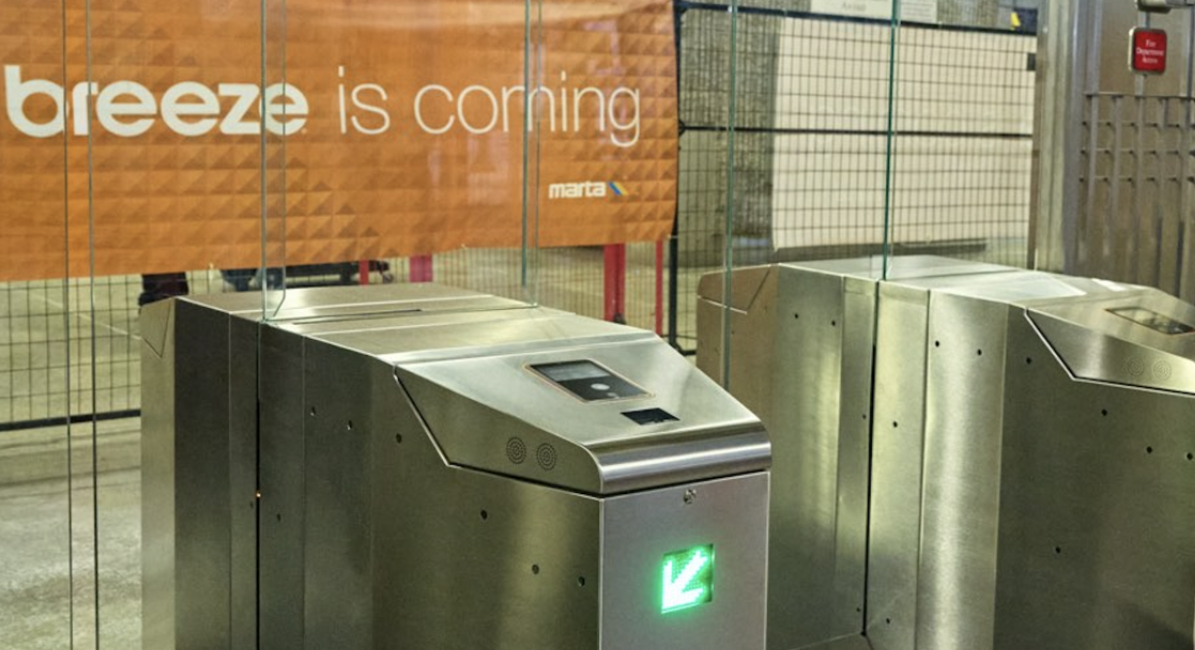
MARTA is installing modern sliding fare gates across Atlanta’s rail stations as the centerpiece of its “Better Breeze” fare-collection overhaul.
The project replaces decades-old equipment that frequently malfunctioned, was easy to bypass, and could not reliably count riders or collect revenue. As of late September 2026, work continues at 14 of MARTA’s 38 stations and is expected to finish by the end of October.
MARTA Installing New Faregates: What To Know
The new gates feature taller partitions, contactless tap-to-pay readers, and remote monitoring. Riders can tap a credit or debit card, a mobile wallet, a new orange Breeze card, or a virtual Breeze card. Old silver Breeze cards and the previous mobile app no longer work.
Why the New Gates Are Necessary
The old fare gates had reached the end of their useful life. They were frequently broken, stuck open, or easy to push through or jump. MARTA officials have described the prior system as being in a “state of disrepair,” with gates that anyone could walk through without paying.
This created two related problems: lost revenue and unreliable ridership data. In some periods MARTA could not accurately count rail passengers because taps were not registering, even as other modes of service showed growth.
Fare evasion was a persistent issue. The old equipment invited opportunistic non-payment—jumping gates, walking through emergency doors left open, or simply pushing past broken barriers. Transit agencies nationally have treated high evasion rates as both a financial drain and a signal of disorder that can undermine rider confidence.
MARTA’s new gates are designed to make those behaviors harder. They include taller barriers specifically intended to deter jumping and can be monitored and adjusted remotely. After some of the initial glass panels were smashed, MARTA switched to thicker half-inch glass and posted warnings that damaging a gate is a felony. Cameras throughout the system support enforcement; police have made arrests for both vandalism and evasion since the new gates began operating.
Revenue protection matters because fares help fund operations. During the prolonged construction period MARTA kept some gates and emergency doors open rather than close station entrances. Officials estimated that choice cost about $9.7 million in uncollected fares but argued it was preferable to shutting stations and disrupting service.
Interim CEO Jonathan Hunt has said the agency prioritized reliability and access while crews worked. Once installation is complete, the expectation is tighter revenue control and more accurate passenger counts.
The upgrade also modernizes the rider experience. Contactless bank-card and mobile-wallet payments reduce the need to buy or reload a dedicated card for every trip. New touchscreen vending machines accept cash and cards and give change. ADA-accessible gates are part of the design. MARTA framed the project as preparation for large events, including the 2026 FIFA World Cup matches held in Atlanta, when the system saw a sharp ridership increase. Officials have said the new equipment is harder to tamper with and supports a more secure station environment.
Rollout and Remaining Work
Installation began in late 2025 at stations such as Lindbergh Center and Doraville. The new system went live in late March 2026, followed by a transition period in which both old and new equipment operated and many gates were left open. Fares were required again starting May 30 at stations with completed new gates. Construction delays pushed the original spring completion target into the fall. Some stations still use a mix of old gates, emergency doors, and new equipment. Riders are advised to have a valid payment method to avoid being unable to exit.
Balances on old cards could be transferred through breezecard.com for a limited window. New physical orange cards cost $2 and store value in an account rather than on the card itself. The one-way fare remains $2.50.
The new gates are not a complete solution to every transit challenge—vandalism occurred even after installation, and the transition created lines and confusion for some reduced-fare customers. They do, however, address the core failures of the previous generation of equipment: unreliability, easy evasion, poor data, and an outdated payment experience. Once the remaining 14 stations are finished, MARTA will have a more consistent, monitorable, and contactless entry system across the rail network.
Final Word
Traveling with your significant other is the best way to go. Looking for a destination? There are some great cities that you can vacation in for cheap right now.
Check Out Our Atlanta Travel Guide
-

Selecting the ideal mattress is still one of the fastest ways to improve rest. Sleeping position, body type, temperature preference, and how much you want to spend matter more than brand hype. The good news for 2026 is that online mattress shopping has matured: long trial periods, better cooling tech, and frequent sitewide discounts make it easier to buy without walking into a showroom.
This article is going to show you some of the top mattresses for getting a good night’s sleep. All of these items are available to purchase online.
Here Are The Best Mattresses For Good Sleep In 2026
We will specifically discuss the following types of mattresses:
Mattresses are one of those items that customers have very little middle ground about. They either love them — meaning they got great sleep — or they hate them (they didn’t sleep at all).
Best Mattresses Overall
So, the following products we’ll showcase have features that many customers enjoy and have found to be valuable.
Ashley Furniture Memory Foam Mattress

Zinus 12-Inch Green Tea Memory Foam Mattress

Gel-Infused Memory Foam Mattress

Medium Firm Feel Mattress (10-Year Warranty)

Gem Memory Foam Bonus Pillow Mattress

Best Mattresses For Side Sleepers
Side sleepers quite literally put themselves in an untenable position. Not only does the habit of sleeping on your side, but uneven strain on a mattress, but it just hurts the body after a while.
If you want a mattress that’s best for side sleepers, you need to consider those with contouring features.
Novella King Mattress

- Leesa In a Box Mattress
- Nectar Queen Mattress
- Sweetnight Breeze Mattress
- GhostBed With Memory Foam
- Tuft & Needle Original Mattress
Best Mattresses For Back Pain
If back pain is a problem of yours, many mattresses may contribute to the issue rather than it solve it, unfortunately. But there are some brands that work better than others.
Here are the best mattresses to relieve back pain.
- Lucid Hybrid Mattress — $412
- Casper Sleep Hybrid Mattress — $1,615
- Classic Brands Mercer Pillow Top Mattress — $361
How To Get Good Sleep
The key to getting good sleep is to follow several good practices that are tried and proven. Let’s get into it:
Listen to Your Body
If you wake up with stiffness, soreness, or pain, especially in your lower back or neck, your mattress or sleeping position may need to be adjusted. Experiment with different sleeping positions, pillow placements, or even a different mattress until you find what works best for you.
Practice Good Sleep Hygiene
Good sleeping posture should be paired with good sleep habits. Maintain a consistent sleep schedule, limit screen time before bed, and create a relaxing environment conducive to restful sleep.
Ensure Proper Mattress Support
- Firmness: The right firmness ensures that your body is supported in a way that maintains natural alignment. A mattress that is too soft can cause your spine to curve unnaturally, while one that is too firm can create pressure points.
- Durability: Check your mattress’s condition. Over time, mattresses can sag, losing their ability to provide proper support. If your mattress is sagging, it may be time for a replacement.
Final Words
Mattress comfort can take many forms, from the bounce of the top layer to the sturdy fit of the bottom layer. A good mattress can be of great quality yet affordable.
Few things are as enjoyable and comforting as resting on a good mattress after a long day’s work. Do you have such a comforting mattress? If not, you can surely get one.
Although once you get to sleep, it’s been said that a good mattress is a dream, one thing we know for sure is that you pay for what you get. Taking the time to research top mattresses, especially those that fit your particular condition whether it’s back pain or you’re a side sleeper, is worth it. We hope that you’ve found a mattress that helps you to rest comfortably. Sleep tight.
Shopping for Gadgets? Scan Our Electronics Page
More Articles For You:
-
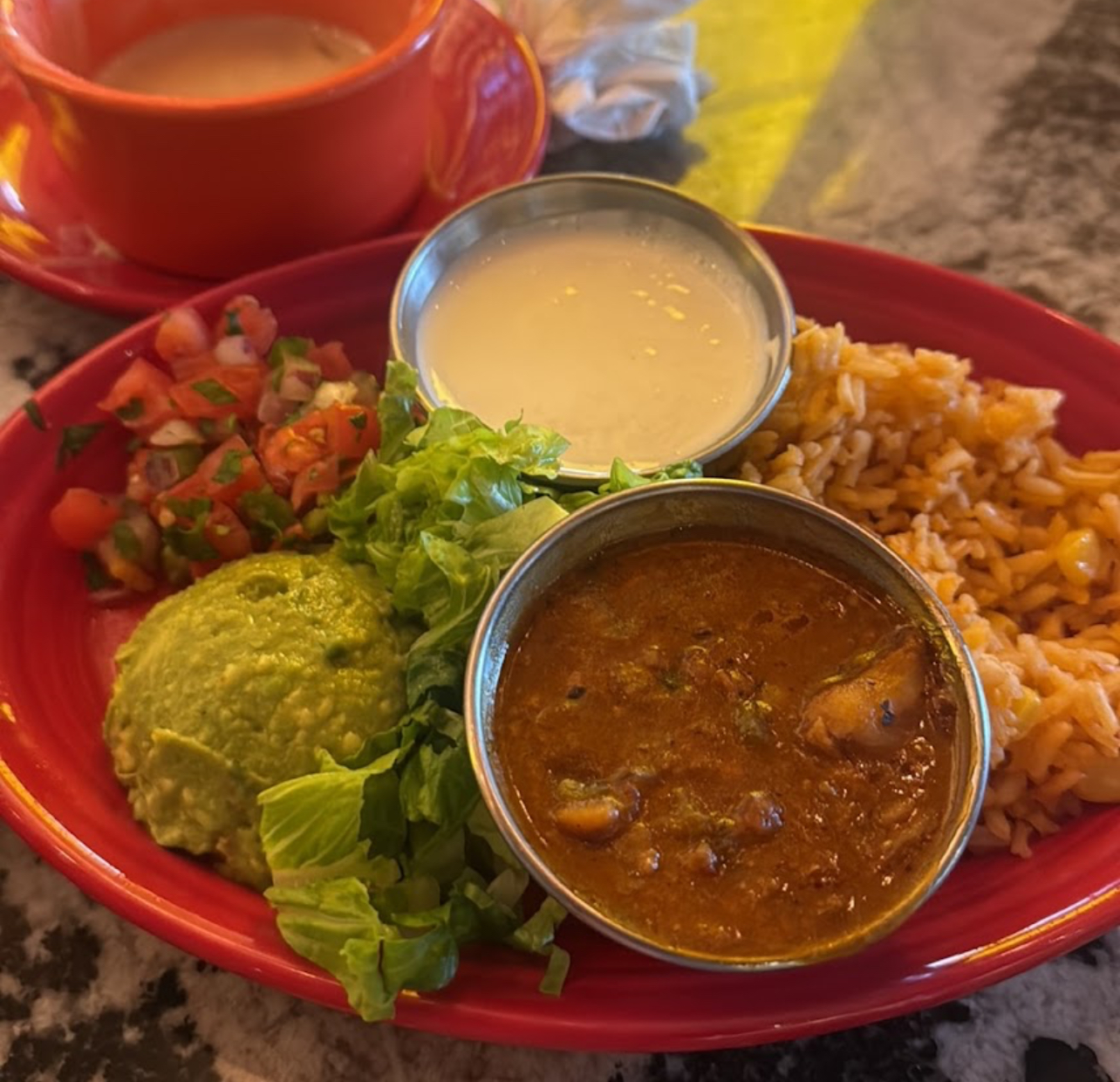
Through October 15, Dos Caminos is turning the table into a celebration of Mexican flavors and community.
The restaurant is offering a $45 three-course prix fixe menu, specialty cocktails, $25 off catering orders of $250 or more, and a $1 donation to LaAmistad for every prix fixe sold.
Dos Caminos Marks Hispanic Heritage Month With a $45 Prix Fixe Menu, Support for LaAmistad
The promotion is part of Dos Caminos Atlanta’s Hispanic Heritage Month observance, running from September 15 through October 15 at 1100 Peachtree Street NE. The seasonal menu highlights regional Mexican ingredients such as Oaxaca cheese, mole poblano, tomatillo salsa, and handmade corn tortillas, with dishes that have included Taquitos de Pollo, Camarones Alambres, Dos Enchiladas, and Carnitas Tacos.
Each prix fixe sold sends $1 to LaAmistad, an Atlanta nonprofit that provides tutoring, mentoring, and family support for Latino students. The catering discount gives hosts another way to join the celebration at a larger scale.
Guests can also receive $25 off catering orders of $250 or more during the celebration, making it easy to bring Dos Caminos’ modern Mexican flavors to Hispanic Heritage Month gatherings and events.
The prix fixe is built as a full three-course meal. Each one begins with chips and queso with ranchero salsa, then a choice of appetizer, entrée, and dessert.
Appetizers
• Taquitos de Pollo: Pulled chicken, sweet potatoes, crema, queso fresco, and tomatillo salsa
• Chopped Salad: Red wine vinaigrette, shaved radish, and cotija cheese
• Camarones Alambres: Pepper jack–stuffed, bacon-wrapped shrimp with chipotle BBQ glaze and pickled jalapeño
Entrées
• Dos Enchiladas: Pastor chicken, corn tortillas, Oaxaca cheese, crema, mole poblano, salsa verde, and sesame seeds
• Carnitas Tacos: Twelve-hour roasted heritage pork, green chile salsa, pickled red onion, handmade corn tortillas, rice, and beans
• Dos Quesadillas: Pulled pastor chicken, Mexican cheeses, pico de gallo, guacamole, charred serrano, and crema
Desserts
• Tres Leches: A classic favorite making its debut on Dos Caminos’ dessert program
• Churros: Served with cajeta and chocolate sauces
• Fried Ice Cream: A crisp-and-creamy finish
The seasonal offering highlights regional Mexican ingredients and house signatures, from mole poblano and Oaxaca cheese to handmade corn tortillas. Specialty cocktails round out the table for diners who want the full celebration experience.
Reservations and details are available through Dos Caminos Atlanta. The offer runs through October 15.
Here Are The Best New Restaurants In Atlanta
-

On National Food Service Worker Day, Giving Kitchen honors 15.7 million workers — and the support they deserve when crisis hits.
September 25 is National Food Service Worker Day, a moment set aside for the 15.7 million people who keep restaurants, cafeterias, coffee shops, and kitchens running. Giving Kitchen, the James Beard Award–winning nonprofit that assists food service workers in crisis, is using the day to do more than say thank you.
National Food Service Worker Day
It is also restating a simple argument: the people who spend their days feeding everyone else should have somewhere to turn when life gets hard.
Food service is the second-largest industry in the country. Its workers create community as much as they create meals. They greet regulars, keep the line moving, and make a dining room feel like a neighborhood. Behind that work, though, are people facing financial strain, food insecurity, isolation, illness, injury, and mental health struggles. Research points to high stress and emotional exhaustion across the industry, along with elevated rates of depression, anxiety, and suicidal ideation. Nearly 4 in 10 food and beverage workers say they experience isolation at work.
That last figure is easy to miss from the guest side of the counter. A busy shift can look like connection. For many workers, it can also feel like standing in a crowded room with no one to lean on.
Hunger among the people who feed us
The day falls during Hunger Action Month, and Giving Kitchen is using that overlap to highlight a bitter contradiction: many of the people who prepare and serve food do not always have enough of it themselves. Research shows three in five restaurant workers experience food insecurity. Among Giving Kitchen’s own clients, more than 70 percent say financial assistance kept them from skipping meals to save money.
“Food service workers spend their days taking care of everyone else. They deserve to be cared for, too,” said Dr. Allison Padilla-Goodman, CEO of Giving Kitchen. “National Food Service Worker Day is an opportunity to say thank you, but gratitude alone isn’t enough. We want food service workers to know that their work has dignity, that they are seen and valued, and that when they’re facing a crisis, they have somewhere to turn.”
Stability as more than emergency aid
That idea sits at the center of Giving Kitchen’s Stability Network, a national effort that connects workers and employers with resources meant to make workplaces more supportive. The network is designed to bring mental health support, crisis resources, and human connection into the places where food service people already spend their days — not only after a disaster, but as part of ordinary working life.
“Stability isn’t just about getting through a crisis,” Padilla-Goodman said. “It’s about rooting people in community and making sure food service workers know that they are not alone. We’re proud to support the second-largest industry in the country by investing in the people who make it possible.”
Since 2013, Giving Kitchen has supported more than 40,000 food service workers facing illness, injury, housing disasters, and the death of a loved one. The organization also offers QPR suicide-prevention training to food service teams; nearly 2,000 workers have completed it. After the training, 94 percent say they feel confident helping someone who may be suicidal, and one in four say they know someone who may need help and intend to reach out. The training is free to food service workers and operators nationwide.
A day for thanks — and for follow-through
National Food Service Worker Day began as Giving Kitchen’s campaign to recognize an industry that touches nearly every American life. Two out of three people in the United States have worked in food service at some point. That is not a niche workforce. It is a national one.
The organization is asking the public to mark September 25 in two ways. First, thank the people behind the pass, the bar, and the register. Second, help make sure workers know help exists. Diners can post a photo or video with #FSWDay and tag @GivingKitchen. Food service workers facing a crisis can ask for help at givingkitchen.org/help.
Gratitude still matters. A sincere thank-you at the end of a shift is not nothing. But Giving Kitchen’s point on this day is sharper than a greeting card: dignity is not only what we say to the people who feed us. It is whether they have a community — and a safety net — when they need one themselves.
Metro Atlanta’s food and drink scene continues to grow with no stops on the horizon. Ready to try something new?
-

Chinese President Xi Jinping has pledged two giant pandas to Zoo Atlanta, reviving Beijing’s decades-old “panda diplomacy” on the opening day of his first state visit to the United States in more than a decade.
Speaking at the White House on Thursday, Xi announced that Ping Ping and Fu Shuang, two giant pandas from a research base in Chengdu, would arrive at the Georgia zoo “in the coming days.” The pair will be Zoo Atlanta’s first pandas since its previous four returned to China in November 2024, when the facility became the last U.S. zoo to lose its bears.
Atlanta is Getting Pandas: Xi Revives Classic Diplomatic Strategy During Summit with Trump
“The giant panda has been an envoy of friendship between the Chinese and Americans,” Xi said. “Here, I have a piece of good news. In a few days, two pandas, Ping Ping and Fu Shuang, will come to their new home in Zoo Atlanta and meet with the American people.”1
The move revives a soft-power tactic China has used since the 1970s, when Beijing first loaned pandas to the United States after President Richard Nixon’s historic opening to China. Over the years, pandas on loan to U.S. zoos have produced 17 cubs, according to Chinese state media. Analysts say the gesture aims to improve the atmosphere between the world’s two largest economies and generate positive momentum in bilateral ties.5
“Panda diplomacy conveys a message of friendship and goodwill from China,” said Wu Xinbo, director of the Center for American Studies at Fudan University.
Xi paired the panda announcement with another people-to-people initiative: an invitation for 100,000 young Americans to visit China for exchanges and study over the next five years. “The hope of the China-U.S. relationship lies in our people, and its future lies with the young,” he said.1
The announcements came as Xi and President Donald Trump began high-stakes talks expected to cover artificial intelligence, tariffs, critical minerals, Taiwan, and the Iran war. Trump greeted Xi planeside at Joint Base Andrews on Wednesday—an unusual welcome for a visiting head of state—and hosted an arrival ceremony at the White House. It is Xi’s first state visit to the U.S. since the Obama administration more than a decade ago.5
China has long used pandas both as symbols of goodwill and, at times, as leverage when relations cool. The National Zoo in Washington, D.C., saw its pandas return to China in 2023 amid heightened tensions; new ones arrived under a fresh agreement a year later. Zoo Atlanta’s earlier group left in 2024 after a 25-year arrangement ended.
With Ping Ping and Fu Shuang on the way, Atlanta will once again join a small group of U.S. zoos hosting the animals. The loan forms part of a conservation agreement with the China Wildlife Conservation Association. Both pandas were born at the Chengdu Research Base of Giant Panda Breeding.
As the two leaders continue their meetings through Friday, the return of the black-and-white ambassadors offers a rare moment of shared warmth in a relationship marked by competition and friction—underscoring how even the most complex geopolitical ties can still find common ground in the simple appeal of pandas.
If you want to explore Atlanta’s cultural palate a bit, a short ride to East Point offers some great places to eat! If you like that part of town, don’t sleep on College Park either.
If you like barbecue, see our list of the Best Atlanta BBQ Restaurants.
As for eateries below I-20, these Southside Atlanta restaurants have developed quite a following.
More Food Coverage from AtlantaFi.com:
Here Are The Best New Restaurants In Atlanta