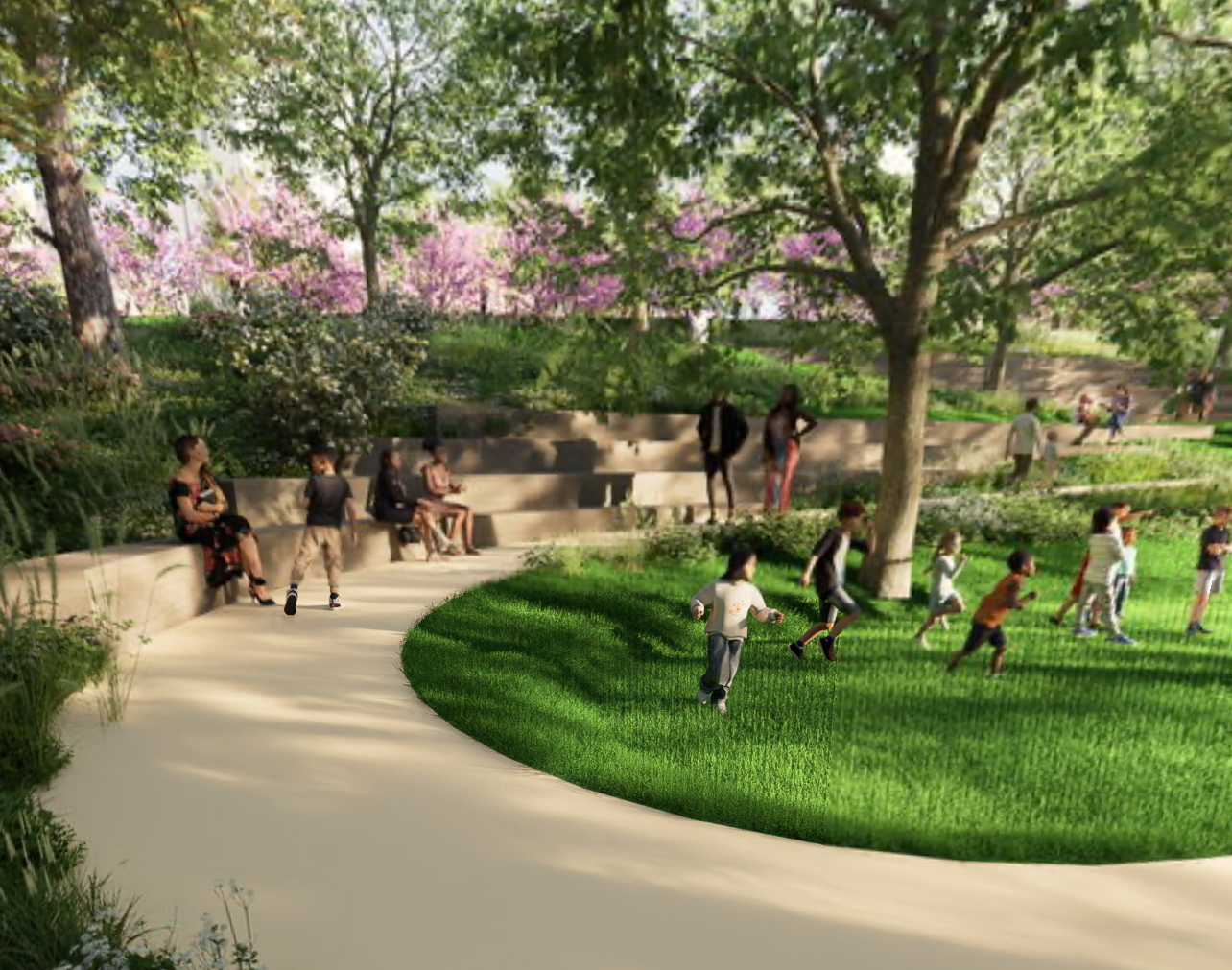

Atlanta project leaders have released fresh, more detailed renderings of “The Stitch,” the long-planned effort to cap a stretch of the Downtown Connector (I-75/I-85) and create a new park-centered district linking Downtown and Midtown.
The latest visuals were unveiled on October 8, 2026, during a summit titled “You Are the Thread” at the National Center for Civil and Human Rights.
Released: New Renderings of ‘The Stitch’ Project in Atlanta
Atlanta Downtown Stitch Inc. president and CEO Jack Cebe led the presentation alongside city and business leaders. The event aimed to build momentum and recruit community stewards as the project advances toward construction.
What the New Renderings Show

The updated images focus on Phase One elements, particularly a Gateway Pavilion and surrounding social spaces. They depict the pavilion in winter, evening concert settings under a shade structure with downtown skyscrapers in the background, and gathering areas looking north toward Midtown. These refine earlier concepts rather than reduce the overall scope, according to project representatives, who clarified that the full multi-phase Master Plan remains intact.
Phase One centers on roughly 5 acres between Peachtree Street (west) and Courtland Street (east), bounded south by Ralph McGill Boulevard and north by the St. Luke’s Episcopal Church campus.
Planned features include a broad tree canopy, multi-use plazas and lawns, an interactive water feature (sometimes described with “Fog Forest” misting capabilities), urban gardens and terraces, an event/shade pavilion suitable for performances or activities like skating, a playground, public art, and pathways. The park would sit atop a new approximately 450-foot bridge structure spanning the highway between the existing Peachtree and Courtland bridges.
Earlier 2025 renderings (from an October Downtown Day event) already illustrated a more compact Phase One with a performance pavilion, fog forest fountain, gardens, and playground; the 2026 visuals add architectural and programming detail to buildings within the park.
Project Background and Scale
The Stitch has been under formal planning for about a decade (with roots in longer community discussions). Its full vision calls for a roughly three-quarter-mile platform spanning the Connector between Ted Turner Drive and Piedmont Avenue, creating approximately 14–17 acres of greenspace, plazas, paths, and development sites.
The goal is to reconnect neighborhoods divided by the interstate more than 70 years ago, catalyze a new “North Downtown” district with housing and mixed-use development, improve walkability, and generate significant economic activity (projections have cited billions in value creation and tens of millions in new annual revenue).
Design work involves Mack Scogin Merrill Elam Architects, WSP engineers, and Hargreaves Jones landscape architects. The Master Plan, shaped by extensive public input, outlines three phases. Phase 1 is the “Heart of the Stitch”; later phases would expand gathering spaces and connections (including toward the Civic Center MARTA station).
Total estimated cost has ranged in the $700–750 million range depending on the estimate and timing, with Phase 1 historically pegged near $200 million.
Funding, Timeline, and Current Status
The project secured major federal support (including a large Reconnecting Communities grant) but lost roughly $151–160 million in 2025 amid broader federal funding changes. Organizers describe this as a setback rather than the end, and about $50 million in local and remaining funds is available to advance design, permitting, and related work.
A Special Services (or Assessment) District, approved by Atlanta City Council, will levy a modest additional tax on certain commercial and rental properties within about half a mile to support operations, maintenance, and programming—similar in concept to mechanisms used for the Beltline.
Leadership formed Atlanta Downtown Stitch Inc. (modeled in part after the Beltline’s nonprofit structure) to oversee delivery. Phase One construction is targeted to begin in 2027. Initial work is expected to focus on streetscape and multimodal improvements along Ralph McGill Boulevard, Peachtree Street, Courtland Street, and other nearby corridors (roughly eight miles of enhancements in the broader area).
Actual highway capping will follow as funding allows. Design is advancing toward shovel-ready status, with Phase 1 completion previously targeted around 2030 and full build-out potentially by 2036, contingent on additional funding.
Community activation is already underway, including public art such as Eddie Farr’s interactive LED sculpture “What We Weave” installed near the site in Mayor’s Park in 2026.
Outlook
Proponents, including Mayor Andre Dickens, frame The Stitch as a once-in-a-generation infrastructure investment that can heal urban divides, support equitable development (with affordability goals for nearby housing), reduce heat-island effects, and strengthen Downtown’s core. Critics and observers note the substantial remaining funding gap for full implementation and the engineering complexity of building over a busy interstate.
The new renderings and the October summit represent the latest step in keeping the vision visible and building support as the project moves from planning into early implementation. Official updates and the Master Plan are available via thestichatl.com.