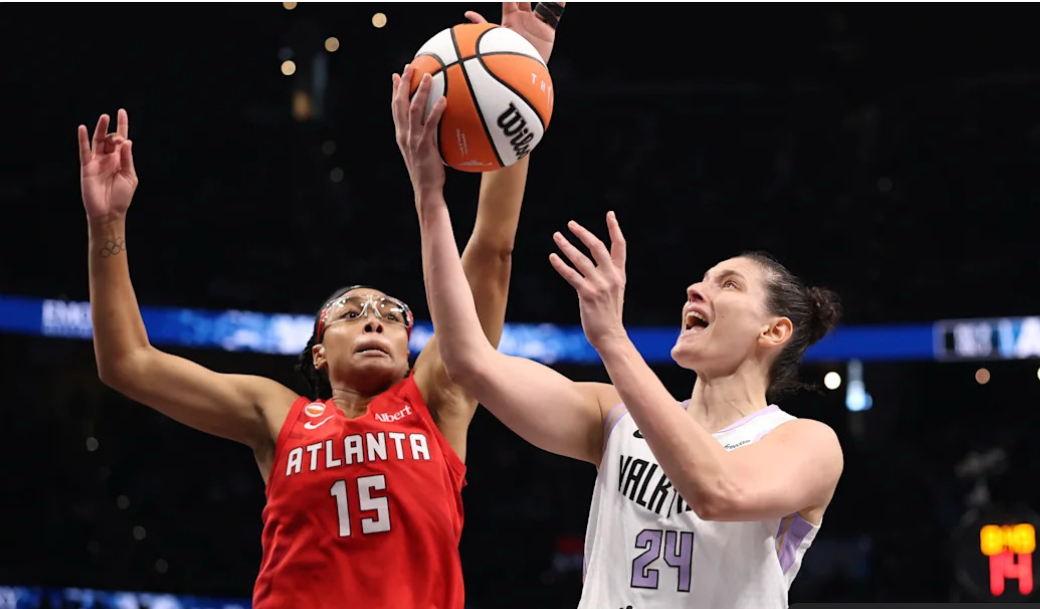

Game 7 of the 2026 WNBA Finals between the Golden State Valkyries and Atlanta Dream drew more than 3.3 million viewers across USA Network, CNBC, and Peacock, according to preliminary Nielsen and Adobe Analytics data reported by Front Office Sports. If the figure holds, it would mark the WNBA’s most-watched game—regular season or postseason—since the league’s inaugural 1997 season.
WNBA Finals Game 7 Draws More Than 3.3 Million Viewers
The Valkyries defeated the Dream 68-63 on Halloween Saturday (October 31) at Chase Center in San Francisco to claim their first championship in just the franchise’s second season of existence. It was the first Game 7 in WNBA Finals history. Gabby Williams powered Golden State with 30 points (including a dominant second half), earning Finals MVP honors in a tightly contested contest that kept viewers locked in until the end.
Front Office Sports reporter Colin Salao first shared the preliminary numbers on X Tuesday, noting final figures were expected later in the day. The report quickly circulated, underscoring the series’ broader success.
Series Averages Set a New High
Based on the available game-by-game figures, the seven-game series averaged approximately 1.89 million viewers—the highest for any WNBA Finals series on record. That surpasses the previous modern high set by the five-game 2024 Liberty-Lynx series (around 1.5–1.6 million).
The breakdown:
- Game 1: 2.1 million (NBC, Peacock)
- Game 2: 1.33 million (USA, CNBC, Peacock)
- Game 3: 1.71 million (USA, CNBC, Peacock)
- Game 4: 1.9 million (NBC, Peacock)
- Game 5: 1.4 million (USA, CNBC, Peacock)
- Game 6: 1.5 million (USA, E!, SYFY, Peacock)
- Game 7: 3.3 million (USA, CNBC, Peacock)
Game 6’s solid number came despite a midday tip-off (12:30 p.m. ET) after scheduling adjustments that drew criticism. The series also set attendance records, drawing over 123,000 fans across the seven games, with Game 7 selling out Chase Center at 18,064.
Historical Significance
Only a handful of WNBA games have cleared the 3-million-viewer mark. The league’s all-time high remains the 1997 opener (New York Liberty at Los Angeles Sparks) at 5.04 million on NBC, followed by the next day’s Charlotte Sting–Phoenix Mercury game at 3.59 million. A 1999 Finals game between the Liberty and Houston Comets reached 3.25 million.
In the modern era, the 2024 All-Star Game (the first featuring Caitlin Clark and Angel Reese) drew 3.44 million on ABC. More recently, the Indiana Fever’s August 23, 2026, regular-season win over the Chicago Sky averaged 3.31 million on NBC and Peacock—the highest regular-season audience since 1997 until potentially being matched or exceeded by this Game 7. The preliminary Finals number sits right in that range, and final metrics will determine the exact ranking.
Before this century, only three regular-season or postseason games had breached 3 million, according to Sports Media Watch data cited by Front Office Sports.
Broader League Momentum
The 2026 season was the WNBA’s 30th and its strongest in years for viewership and engagement. The regular season produced a record of more than 90 million unique national viewers, 51 telecasts over 1 million (up from 19 the prior year), and more than 320 million hours consumed. NBC’s return to WNBA coverage after a long absence, alongside platforms including USA Network, Peacock, and others under the new media-rights deal, helped amplify the reach.
Notably, the Finals produced these numbers without Caitlin Clark, whose Indiana Fever drove many of the season’s highest regular-season audiences. Stars like Gabby Williams, Angel Reese, and others carried the spotlight, demonstrating the league’s broadening appeal beyond any single player. The Valkyries’ rapid rise—from expansion team to champion in two years—added narrative excitement that translated into viewers.
USA Network and related platforms had already posted strong cable numbers throughout the series, with several games ranking among the highest-rated Finals contests on cable in league history.
These preliminary figures arrive as the WNBA continues negotiating a new collective bargaining agreement and capitalizing on its growth trajectory. Final official viewership numbers from Nielsen and the networks will refine the picture, but the early data already positions Game 7 as a landmark moment for the league’s postseason reach.