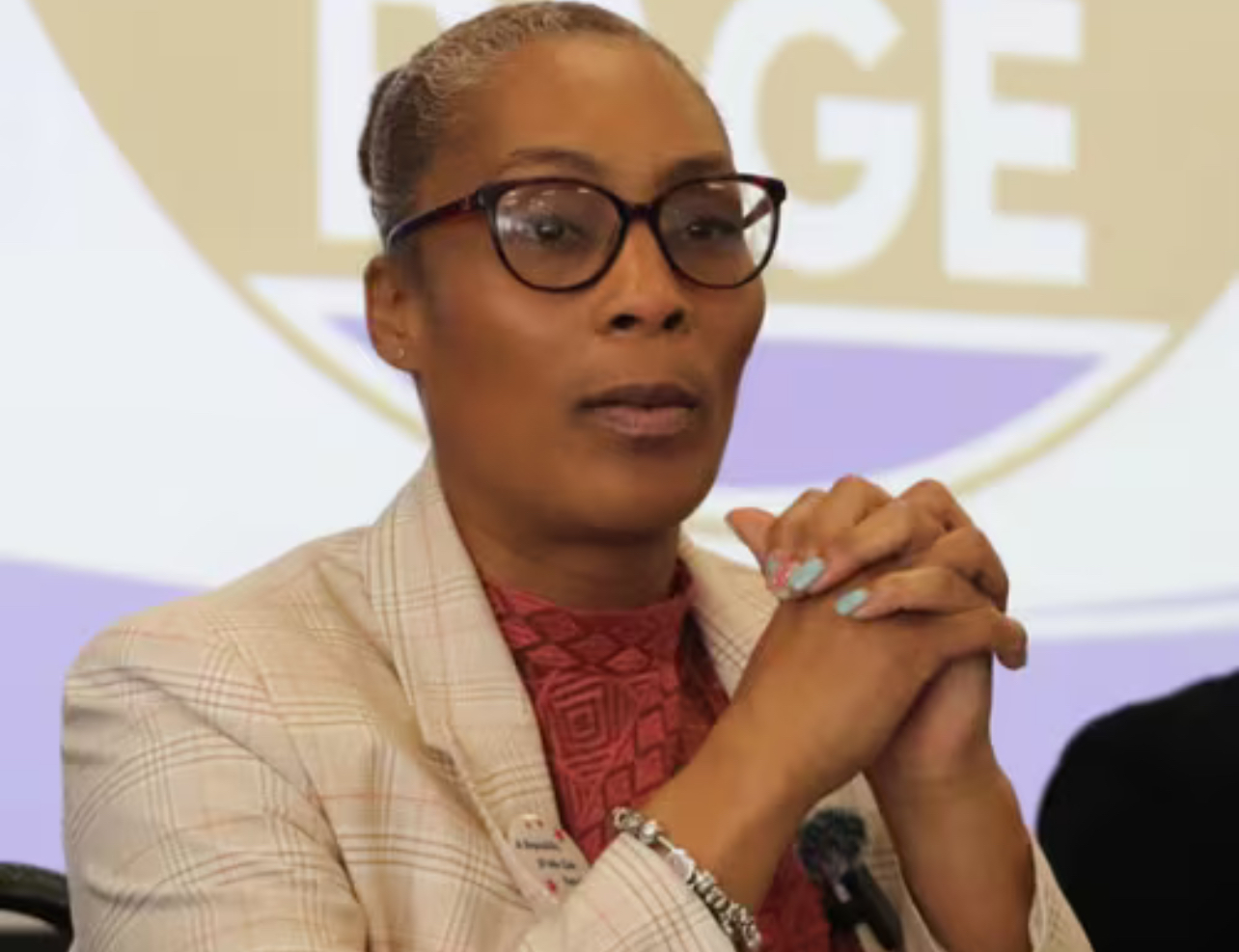

Georgia’s new school superintendent faces backlash over push to scale back standardized testing, prompting sharp criticism that accountability is at risk.
Georgia’s newly elected State School Superintendent Lydia Powell has received criticism after comments she made on Georgia students’ heavy reliance on standardized testing.
Powell, one of several Black women elected into executive office in the state, also said that such testing has stressed teachers and narrows instruction.
We interviewed a parent in Henry County who said that standardized tests have some value.
”I’m not so sure about getting rid of standardized testing,” said Ollie Anderson, whose son is in high school. “Even if you scale it down, how much is too much?”
Powell, a Democrat and longtime educator, defeated Republican incumbent Richard Woods in the November 3, 2026, general election with about 54.6% of the vote. She is set to take office in January 2027 as the first Black woman and the first Democrat in more than three decades to hold the statewide post.
A 26-year veteran of classrooms and administration (most recently as an assistant principal in Henry County), she also has experience as an adjunct professor and diversity trainer.
Powell’s position on testing
In campaign materials and public comments, Powell has argued that teachers spend excessive time on test preparation at the expense of deeper learning. She has called for reducing over-reliance on high-stakes standardized tests, greater professional trust in educators, and “smart assessment practices.”
In one widely circulated clip, she discusses how the current system channels effort toward standardized testing and metrics such as the College and Career Ready Performance Index (CCRPI), pressures teachers to “teach through a test,” and questions whether graduating students are adequately prepared for the workforce. She has also emphasized priorities such as expanding prekindergarten access and strengthening early reading instruction.
Some accounts of her views describe interest in limiting high-stakes testing to fewer grade levels and exploring alternatives such as portfolios or capstone projects. Critics interpret these ideas as a broader “war on testing.”
The criticism
Concha’s reaction reflects a common conservative critique: that dialing back standardized assessments reduces transparency and accountability for student outcomes. Commentators have pointed to persistent challenges in reading proficiency. Georgia data have shown roughly 65% of third-graders reading at or above grade level in recent years, leaving a substantial share below. National Assessment of Educational Progress (NAEP) results have also highlighted widespread struggles with basic reading among high-school seniors.
Opponents argue that test scores give parents and the public an objective measure of whether schools are teaching foundational skills. Removing or heavily diluting that “scoreboard,” they contend, makes it easier for underperforming schools to obscure results while adults experience less pressure.
Some social-media responses framed the approach as prioritizing adult comfort over student mastery and warned of long-term consequences for workforce readiness and civic competence.
Broader context
Debates over standardized testing are not new in Georgia or nationally. Teachers and administrators have long complained about testing volume, stress on students, curriculum narrowing, and the weight of metrics like CCRPI in evaluations and school ratings.
Past Georgia discussions have included efforts to reduce testing burdens while maintaining some accountability under federal and state requirements. Both major-party candidates in the 2026 superintendent race expressed interest in cutting back on testing to some degree, though Powell’s framing has drawn particular attention post-election.
Powell’s full agenda also includes teacher support and pay considerations, special-education accountability, rural student supports, and changes to school funding formulas. She has described her first 100 days as focused on operational reviews at the Georgia Department of Education and collaboration on early-childhood expansion.
The exchange captured in Concha’s post underscores a deeper philosophical divide: whether rigorous, comparable testing is essential for measuring progress and driving improvement, or whether it has become counterproductive and should yield to more flexible, teacher-centered approaches. As Powell prepares to assume office, the practical details of any testing reforms—and their measurable effects on student achievement—will face close scrutiny from parents, educators, and policymakers across the state.