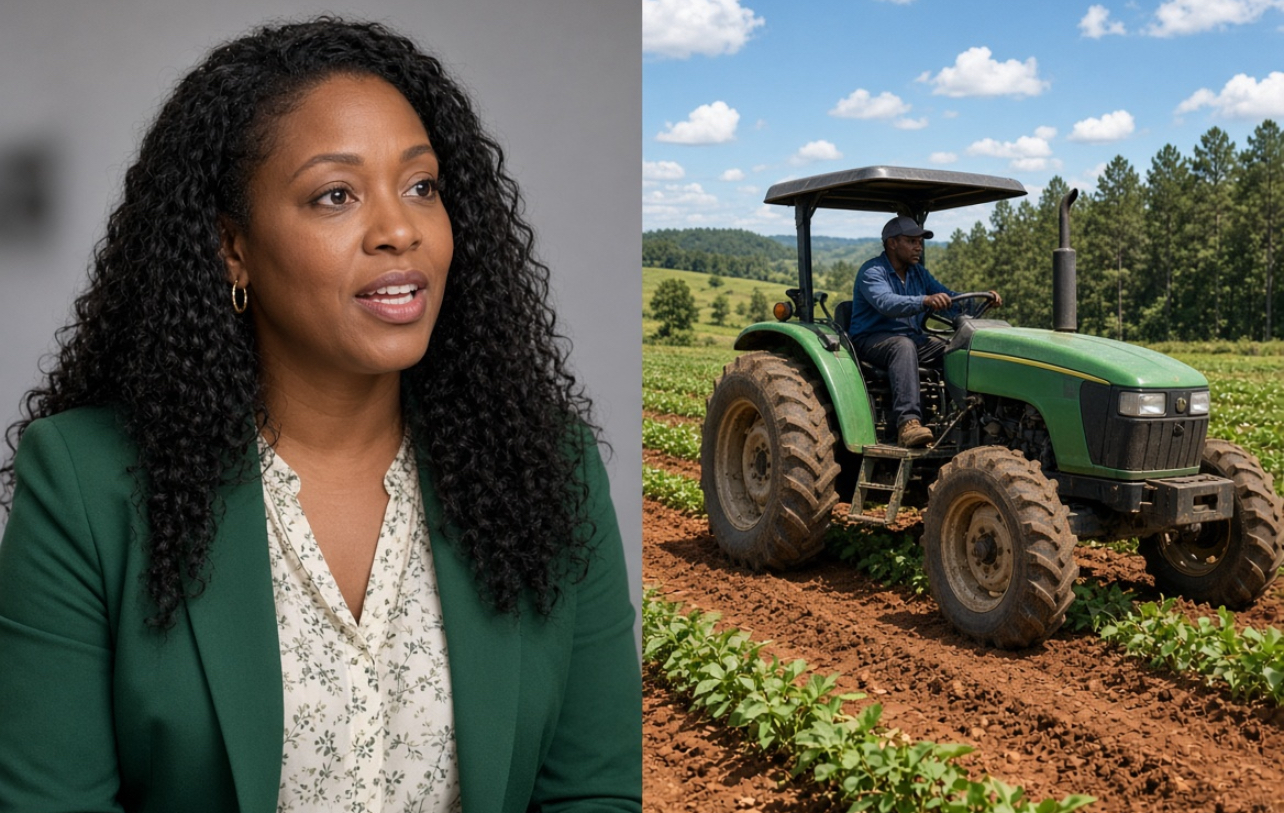

Georgia’s incoming Agriculture Commissioner Katherine Juhan-Arnold has stated plans to allocate state budget resources toward Black farmers (alongside beginning farmers and those disconnected from assistance), drawing attention to longstanding disparities while raising questions about race-based policy.
Recently elected to her post in Georgia alongside a slew of Black women executives, Juhan-Arnold noted: “We have the budget to allocate funds for our black farmers, for our beginning farmers, for people who have a disconnect.”
She linked the idea to personal family history involving heirs’ property in Richland, Georgia, and the need for re-education on protecting land and navigating agricultural systems. She is the first woman and first Black person elected to the post, defeating incumbent Republican Tyler Harper in the November 2026 election after founding a nonprofit focused on fresh food and gardening in low-income communities.
Georgia has roughly 67,000 farm producers, of whom about 2,700 (around 4%) are Black or African American according to 2022 USDA Census of Agriculture data; they operate a fraction of the state’s farmland.
Land Loss, Disparities in the South and the Plight of the Black Farmer
Black farmers’ challenges in Georgia and the broader South stem from a long trajectory of land acquisition followed by steep decline. After emancipation, many formerly enslaved people sought land ownership as a foundation for economic independence. Peak ownership occurred around 1910–1920, when Black farmers operated roughly 925,000 farms nationwide (about 14% of all U.S. farms) and held an estimated 16–20 million acres, concentrated in the South.
That position eroded dramatically. Between 1910/1920 and the late 20th century, Black-owned farmland fell by roughly 90%, with the number of Black farm operators dropping by 90–98% in various measures.
White farmland ownership remained far more stable over comparable periods. Estimates of the wealth and income lost from this land range into the hundreds of billions of dollars (one analysis put the figure around $326 billion in present value for losses from 1920–1997). In Georgia and neighboring states, factors included discriminatory lending and credit practices by the USDA and local institutions, denial or delay of loans and disaster assistance, sharecropping and tenancy systems that limited accumulation of equity, and heirs’ property issues.
Heirs’ property—land passed down without clear title or wills—has been a persistent barrier.
We interviewed a woman who owns land in Houston County that was passed down to her and her siblings through heirs property.
“Biggest mess you ever saw,” Tina Rollins, who stays with her daughter in Acworth, says. “Dividing the land up like that is basically like dividing the family,” she said.
Rollins said a developer was eventually able to wrestle the property from the family. It’s a strip mall now.
Wirh heirs property, multiple heirs hold undivided interests, complicating loans, sales, or improvements and making the land vulnerable to partition sales or loss. Juhan-Arnold referenced this in her own family’s experience. Economic pressures, mechanization, the Great Migration, and broader farm consolidation amplified losses. By recent censuses, Black farmers constitute roughly 1–2% of U.S. producers nationally and a small share in Georgia, often on smaller operations with less access to capital, markets, and technical support.
Read up on how to buy land in Georgia.
Federal recognition of discrimination came via the Pigford v. Glickman class-action litigation (and the subsequent Pigford II process). Black farmers alleged USDA denied or delayed loans, benefits, and credit on the basis of race from the 1980s into the 1990s, while also failing to properly process discrimination complaints.
Settlements ultimately provided more than $2 billion in payments, debt relief, and related assistance to tens of thousands of claimants (original Track A awards were commonly $50,000 plus potential debt forgiveness; later rounds addressed late filers). Critics and participants have noted administrative complexities, incomplete reach, and ongoing challenges with debt and access.
In the South, these patterns interacted with Jim Crow-era restrictions, local power structures controlling USDA county committees, and unequal enforcement of New Deal and later farm programs that sometimes favored larger, white-owned operations. Black farmers today continue to report hurdles in credit, information access, and scaling operations, though outcomes vary widely by individual circumstances, crop type, and location.
Current Landscape and Policy Debate
Georgia’s agricultural sector remains the state’s largest industry, encompassing row crops, poultry, timber, specialty crops, and more. Black farmers contribute within this economy but face the same structural pressures as many smaller producers—rising input costs, weather risks (including recovery from events like Hurricane Helene), market concentration, and competition—plus the residual effects of historical disparities.
Outreach programs, technical assistance, and recognition efforts (such as Georgia’s prior designation of Black Farmers Month) already exist.
Juhan-Arnold’s emphasis on “underserved producers,” regional support, education on heirs’ property and systems navigation, and targeting resources toward Black farmers and beginning farmers reflects one approach: race-conscious or equity-focused interventions to close gaps. Supporters argue this addresses documented historical discrimination and current underrepresentation.
Critics contend that allocating taxpayer funds explicitly by race constitutes discrimination, risks legal challenges under equal-protection standards (strict scrutiny applies to racial classifications), and is better replaced by need-based, race-neutral criteria focused on hardship, farm size, credit access, or property issues. Federal courts and prior USDA efforts have navigated similar tensions; race-exclusive programs face higher constitutional hurdles than those using race as one factor among many or targeting socio-economic disadvantage.
Practical realities include limited state agriculture department budgets relative to federal programs, the small absolute number of Black farmers in Georgia, and the need for clear eligibility rules, transparency, and measurable outcomes. Broader Southern trends show ongoing farm consolidation, rural demographic shifts, and debates over how best to sustain family and minority operations amid technological and global market changes.
The historical record of land loss, documented USDA discrimination addressed through major settlements, and persistent gaps in numbers and scale for Black farmers in Georgia and the South are clear. How policymakers respond—through targeted outreach, education on title and credit issues, expanded general access programs, or race-specific funding—remains contested, with legal, practical, and political constraints shaping what is feasible.
Effective support for struggling farmers of any background ultimately depends on addressing credit, markets, knowledge, and land tenure barriers with evidence-based tools rather than symbolism alone.