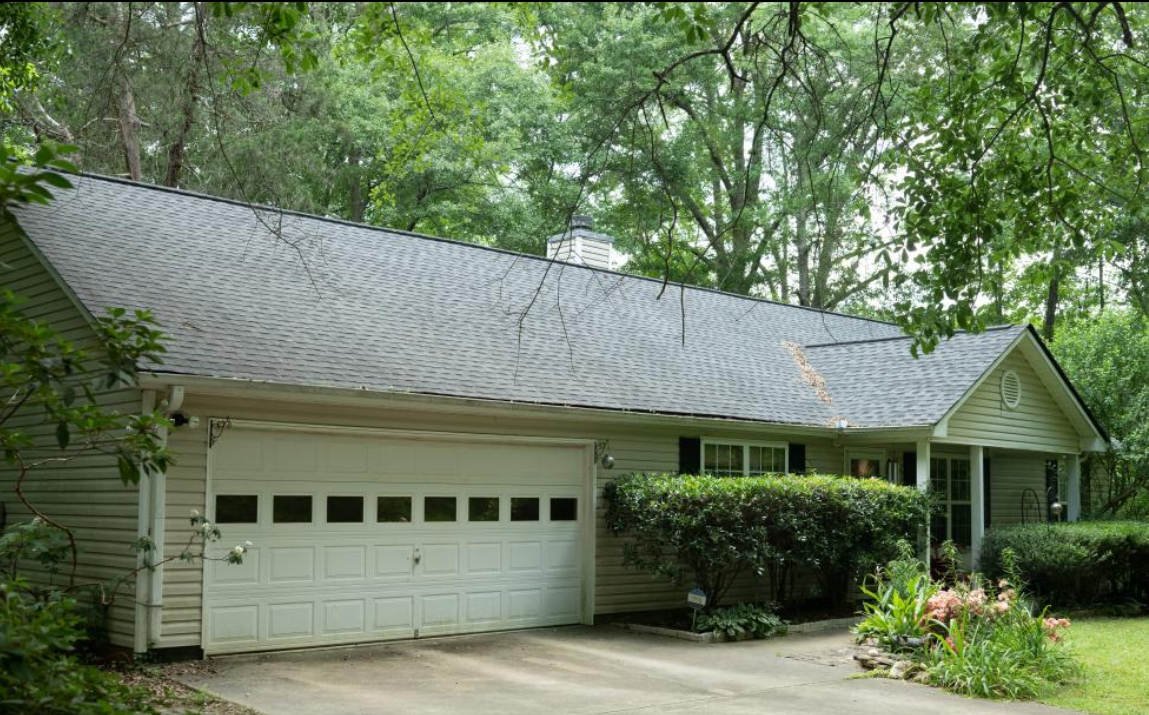

On Saturday, Ansley Brown stood in the driveway of her childhood home in Newnan, a U-Haul parked behind her, and recorded a farewell. “Today is the day we say goodbye to my childhood home,” she wrote. “Soon to be demolished by Georgia Power for the data centers.”
The video spread quickly. Within hours it had tens of thousands of views; by Sunday it was well past 170,000, with thousands of likes and a comment from former Rep. Marjorie Taylor Greene thanking her for fighting for her mother and her community.
Georgia Woman: My Home To Be Demolished for Data Centers
We interviewed a woman who says she doesn’t mind data centers. “As long as the local city and county get something out of the deal, I think it could be a win,” says John Preston of Sharpsburg.
When it comes to Brown’s home, she disagrees.
The house itself is modest: a pale ranch under trees, bought in 2003 by Brown’s mother, Angela Hall, with a USDA loan meant for single mothers in rural areas. Brown has said the place shaped who she is. Georgia Power is taking it anyway, not for a data-center building but for the right-of-way of a 35-mile, 500-kilovolt transmission corridor known as the Ashley Park–Wansley line.
The corridor cuts through Coweta and Fayette counties and is designed to move power from the revived Plant Wansley complex toward the Atlanta suburbs and a cluster of large computing campuses. About 330 properties sit on the route. Between 20 and 30 houses are expected to be demolished. Hundreds more will get permanent easements that put high-voltage towers close to bedrooms and backyards.
After months of negotiation, public videos, and pressure from lawmakers, Hall secured a price Brown’s supporters describe as $205,000 above her own appraisal and $275,000 above a Zillow estimate. Georgia Power says it negotiated in good faith, that eminent domain is a last resort used in less than 1 percent of its land deals, and that the line serves broader load growth—manufacturing and households as well as data centers—not a single customer. Brown’s reply has been consistent: the line exists because Georgia Power is recruiting data-center load, and her county did not vote for this trade.
That argument is no longer confined to one driveway. Georgia has become one of the country’s fastest-growing data-center markets and, at the same time, one of the loudest centers of opposition. Cheap land, available transmission, and a generous sales-tax exemption pulled in Meta, Amazon, Microsoft/QTS, Google, OpenAI, and a long list of smaller developers.
The exemption’s cost to the state ballooned from roughly $10 million in 2020 toward hundreds of millions a year; one audit put the figure near $625 million in a coming fiscal year and found that most of the construction would likely have happened without the break. Georgia Power has planned roughly 10 gigawatts of new generation and billions in grid work, with company and regulatory documents indicating that the large majority of that new power is expected to serve data centers.
Residents’ objections cluster around four things: water, electricity, land, and process.
In Newton, Morgan, and Walton counties, families living across the road from Meta’s Stanton Springs campus have shown jars of brown, silty well water and sued, saying blasting and excavation wrecked a shared aquifer. Meta commissioned a study that found no adverse effect; the families say they now buy bottled water and watch property values fall. Similar well and pressure complaints have surfaced near other sites.
Data centers’ cooling demand varies by design—some use closed loops and far less water than early estimates—but construction itself has already become a flashpoint.
Power is the second fight. Opponents fear residential rates will absorb the cost of new gas plants and transmission even when contracts say large customers pay their share. Supporters and the utility point to Public Service Commission language meant to keep existing residential rates from subsidizing new commercial load, and to the tax base and construction jobs that campuses bring.
The politics have already shifted: discontent over rates and data centers helped Democrats win two Public Service Commission seats, and the issue is now a regular feature of local and statewide campaigns.
Land use is the third. Coweta County’s Project Sail—an 829-acre, nine-building, roughly 900-megawatt campus on land that had been zoned rural conservation—became a statewide symbol. Neighbors organized, sued over the rezoning, and gathered a reported 14,000 petition signatures in an effort to force a home-rule referendum. Commissioners later unanimously denied a separate project, Project Oak.
Similar fights have broken out in DeKalb, Coweta, Effingham, Muscogee, Troup, Lowndes, Bartow, and a dozen other places. By mid-2026, dozens of cities and counties had passed or extended moratoriums or written new ordinances with setbacks, generator rules, and sewer requirements. Atlanta, Palmetto, and Fayetteville have effectively barred new facilities.
Process is what turned many of those fights bitter. Recruitment often happened under nondisclosure agreements. Local officials sometimes learned details only after deals were effectively done.
In Effingham County, OpenAI’s Project Camellia—a $20 billion, 4-million-square-foot campus projected at 3.2 gigawatts, larger than all the Atlanta-area projects then under construction combined—was announced after months of closed talks. Crowds of nearly a thousand packed an open house. Sen. Raphael Warnock showed up. The Southern Environmental Law Center sued, arguing sunshine-law violations.
A development-authority member was quoted saying that if the public had been asked first, they would have said no. OpenAI and local officials have pointed to existing industrial zoning, community-investment pledges, and a closed-loop cooling design. The lawsuit is the latest, not the first.
The pattern is now national, but Georgia is a concentrated case. A 2025 report found opposition blocking or delaying tens of billions of dollars in projects in a single quarter, with Georgia and Indiana leading the wave. The resistance is not neatly partisan. Rural Trump counties and suburban Democratic precincts have used the same toolkit: packed commission meetings, Facebook groups with thousands of members, yard signs, lawsuits, moratoriums, and ballot petitions.
Industry groups argue that the facilities are the physical plant of cloud computing and AI, that they pay more than their incremental cost in many contracts, and that Georgia will lose the investment to other states if it slams the door. Opponents answer that the jobs after construction are few, the water and power draws are large, the tax incentives are a transfer from everyone else, and the secrecy is incompatible with local self-government.
Brown’s house is a small piece of a much larger transmission map. Georgia Power is adding more than a thousand miles of lines. Plant Wansley, once coal, is being rebuilt with combined-cycle gas and batteries, backed in part by a multi-billion-dollar Department of Energy loan to Southern Company. The company says the work is needed for reliability as demand spikes. Brown says the spike was invited.
By Sunday the U-Haul was loaded. The house will come down so towers can go up so servers can stay on. That transaction—private memory exchanged for public-utility infrastructure that mostly serves private computing load—is what the Georgia backlash is about. Whether the next round of projects is slowed by moratoriums, rewritten by ordinances, overturned by voters, or simply built on different parcels will be decided county by county. The goodbye video is only the latest document in a fight that has already changed how Georgia talks about growth.