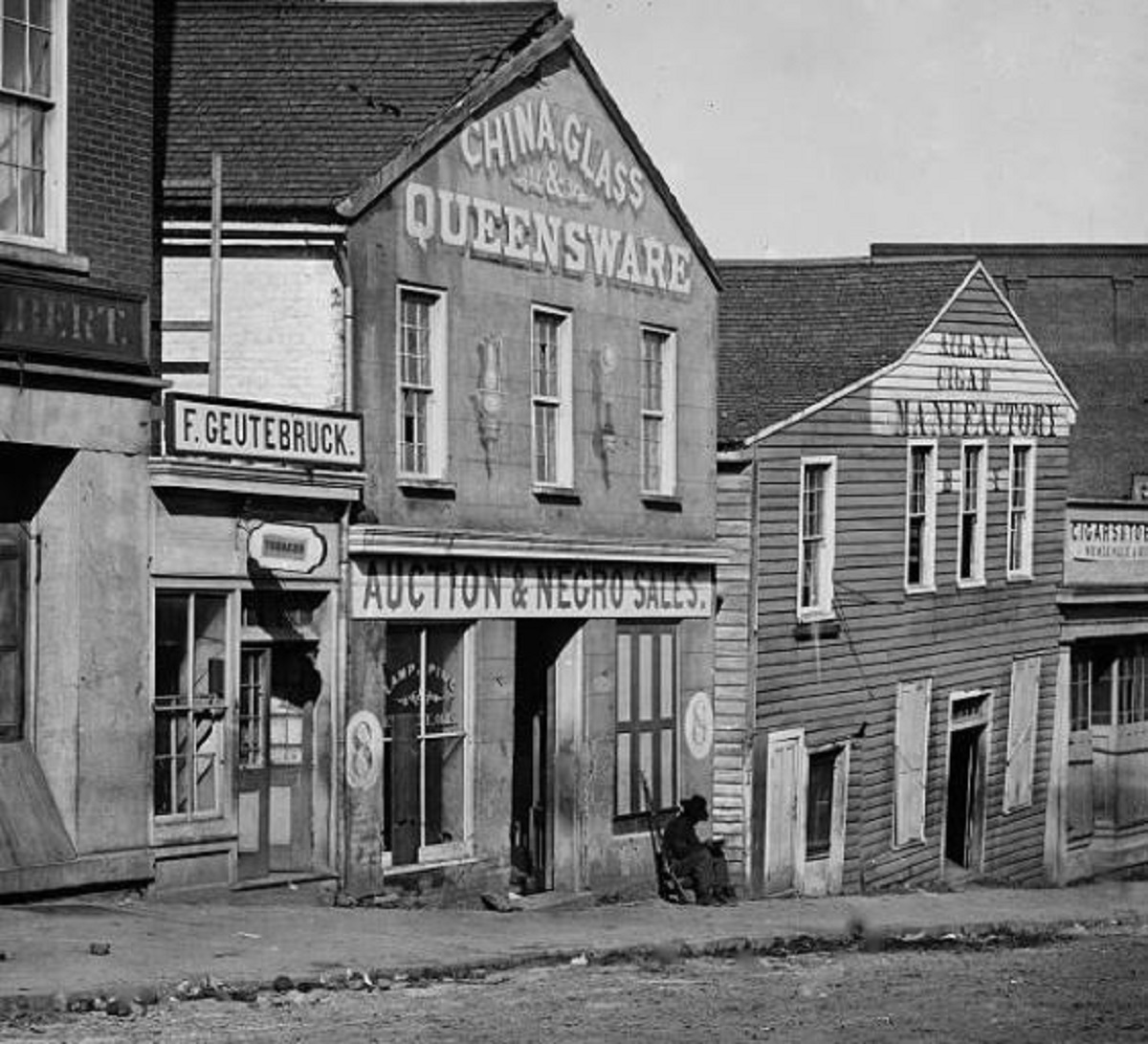

In the fall of 1864, as Union forces occupied Atlanta following its capture by General William T. Sherman, photographer George N. Barnard captured one of the most haunting images of the Civil War era.
His stereograph, taken on Whitehall Street, shows a modest two-story brick storefront with a bold sign reading “Auction & Negro Sales.” Seated casually in front, rifle at his side, is an African American soldier from the United States Colored Troops—his presence a silent rebuke to the building’s former purpose.
“War is hell.” That familiar phrase was reportedly first uttered by Union General Tecumseh Sherman during the Civil War. Sherman commanded more than 100,000 troops as destroyed the American South town by town in the infamous “March to the Sea.”
Did You Know About The Slave Auction House In Atlanta?
One of the cities in his wake was Atlanta, then a teetering rail town. There are photographs that exist of much of the carnage, thanks to official Union photographer George N. Barnard, who was embedded with the soldiers.
In 1866, Barnard published one of the most important war photography projects of all time, “Photographic Views of Sherman’s Campaign.”
Much of Atlanta’s landscape was part of Sherman’s activities. As Georgia Tech’s historical account observes, “In anticipation of advancing Union troops in the summer of 1864, several forts were built on what is now Georgia Tech land. Seen as strategically high ground, land along the southern edge of campus was cleared and fortified by the Confederacy to prevent direct frontal attacks on the city.”
One of the more iconic pictures taken during Sherman’s invasion of Atlanta shows a structure on Whitehall Street used to hold slave auctions all but abandoned. Whitehall Street today is in the middle of a den of old, abandoned buildings, open and wild fields and liquor stores.
Atlanta’s Rise as a Slave-Trading Hub
When Georgia first legalized slavery in 1750, the institution took root slowly in the colony’s coastal plantations. By the antebellum decades, however, Atlanta—then a young railroad boomtown—emerged as a major inland market for enslaved labor.
The city’s population of enslaved people swelled from 493 in 1850 to more than 2,500 by 1863, comprising roughly one-fifth of its residents. Most enslavers held only one or two individuals, but the city’s commercial elite relied on larger holdings for railroads, hotels, and domestic service.
Slave trading became a civic enterprise. Atlanta’s newspapers ran matter-of-fact advertisements promising “field hands, cooks, and wet nurses,” placed beside listings for dry goods.
The city council even imposed a two-dollar tax on every enslaved man, woman, and child sold within its limits, turning human commerce into municipal revenue.
Enslaved people arrived by rail in shackled coffles, held in nearby pens—sometimes called “slave yards” or the “Slave Stone Holding Pen”—before being marched to auction blocks on Whitehall Street or in Kenny’s Alley (now part of Underground Atlanta).
Families were torn apart with clinical efficiency: on one documented day in 1863, Harry, 34, and Hannah, 30, were sold together for $3,600 in Confederate currency, described only as “sound in body and mind.”
Atlanta has a lot of inspirational people and AtlantaFi.com is going to introduce you to many of them as well as cool places to go, great restaurants and other ATL happenings.
Got an event or know of something opening in and around Atlanta? Holla: CJ@AtlantaFi.com. See what’s poppin’ in the ATL! Subscribe to our news alerts here, follow us on Twitter and like us on Facebook.