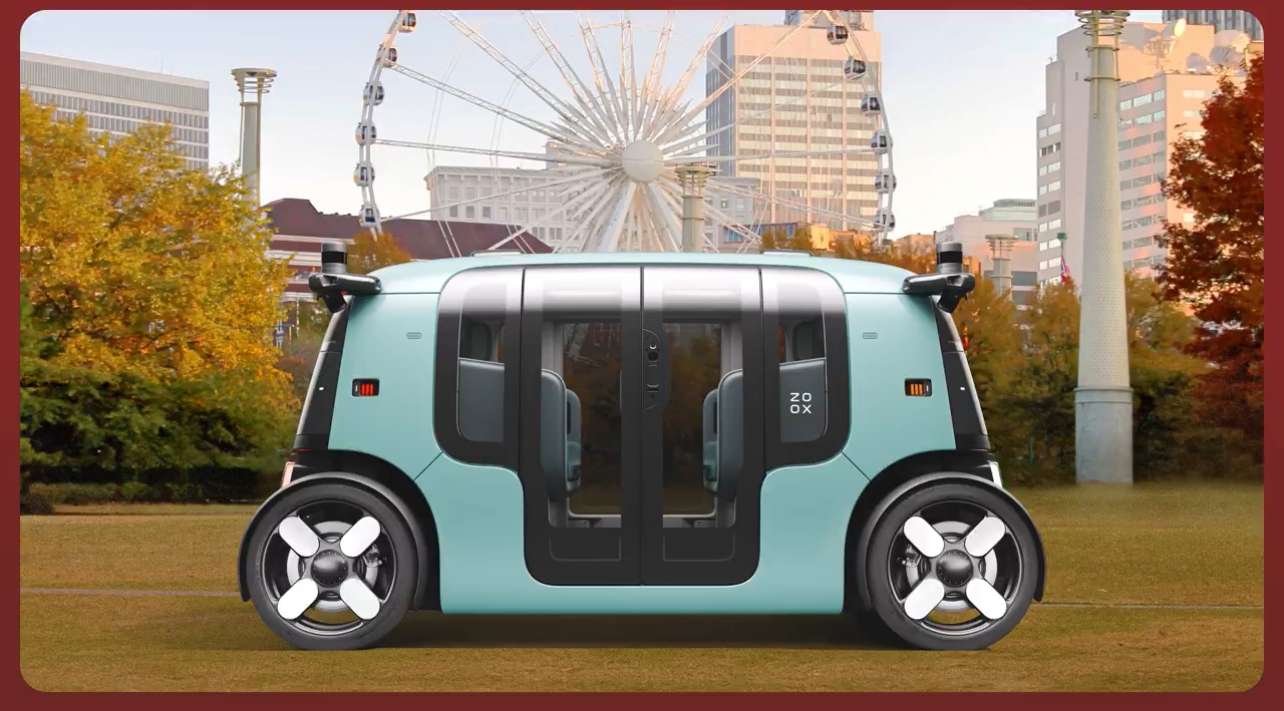

Amazon’s Zoox has introduced its purpose-built 4-passenger driverless robotaxis to Atlanta, beginning operations in northwest neighborhoods near Atlantic Station, Woodward, and Home Park.
Announced on November 13, 2026, the Amazon-owned company (acquired in 2020) confirmed that its distinctive robotaxi is now driving on public streets in the city.
We interviewed a regular rideshare passenger and asked if she would give Zoox a try. “Sure, as long as it gets me where I need to go,” said Sandy Kemp of Riverdale.
Amazon’s Zoox Introduces 4-Passenger Driverless Robotaxis To Atlanta
The initial phase is limited: rides are available exclusively to Zoox employees, their families, and friends. A public waitlist is expected to open in the coming months, ahead of the launch of the Zoox Explorers early rider program (reports indicate this is targeted for 2027).
Zoox has been active in Atlanta since spring 2025. It first used a testing fleet of retrofitted SUVs with safety drivers to map streets, study local driving behaviors, weather patterns (including frequent thunderstorms), and infrastructure. It has since progressed to autonomous driving while expanding its geofence, fleet size, and local team.
The Vehicle
Unlike many competitors that retrofit existing cars, Zoox designed its robotaxi from the ground up for fully autonomous ride-hailing. It has no steering wheel, pedals, or driver’s seat. Instead, it features spacious carriage-style seating for up to four passengers facing one another, creating a more social, lounge-like interior with features such as cupholders and wireless charging.
The vehicle is bidirectional (it can drive equally well in either direction) and symmetrical, with sensors at the corners for a full 360-degree view. Zoox states it is currently the only company deploying a fully driverless, purpose-built robotaxi on U.S. public roads.
Ron Thaniel, Zoox’s senior director of policy and regulatory affairs, said: “We’re grateful to the City of Atlanta and the state of Georgia for their collaboration as we introduce a new kind of vehicle and rider experience to the city.” CEO Aicha Evans also highlighted the milestone on social media, noting the progression from employee rides toward a broader early-rider program.
Why Atlanta?
Zoox describes Atlanta as the “Silicon Valley of the South”—a dynamic tech hub with one of the largest ride-hailing markets in the U.S., a dense urban layout, and a growing population that creates strong demand for efficient on-demand transportation. The city has become a notable hub for autonomous vehicle testing.
Atlanta already hosts other services: Waymo operates public, unsupervised driverless rides (currently primarily via Uber), while May Mobility runs public robotaxi service with a safety supervisor (via Lyft). Zoox’s arrival adds a distinctly different vehicle form factor to the mix.
Broader Context and Next Steps
Atlanta joins Zoox’s other testing markets in Austin and Miami. The company already offers public (paid) service in Las Vegas and runs its Explorers early rider program in San Francisco. It plans to expand the Atlanta operating area as testing progresses throughout the year.
Zoox owns, operates, and assembles its vehicles (with production facilities in California). The Atlanta rollout continues a deliberate multi-year expansion strategy that emphasizes mapping and local adaptation before wider public access.
For now, residents in northwest Atlanta near Atlantic Station, Woodward, and Home Park may spot the teal, boxy robotaxis on the streets. Broader public access remains months away, but the company has positioned the city as a key next market for its unique autonomous ride-hailing experience.