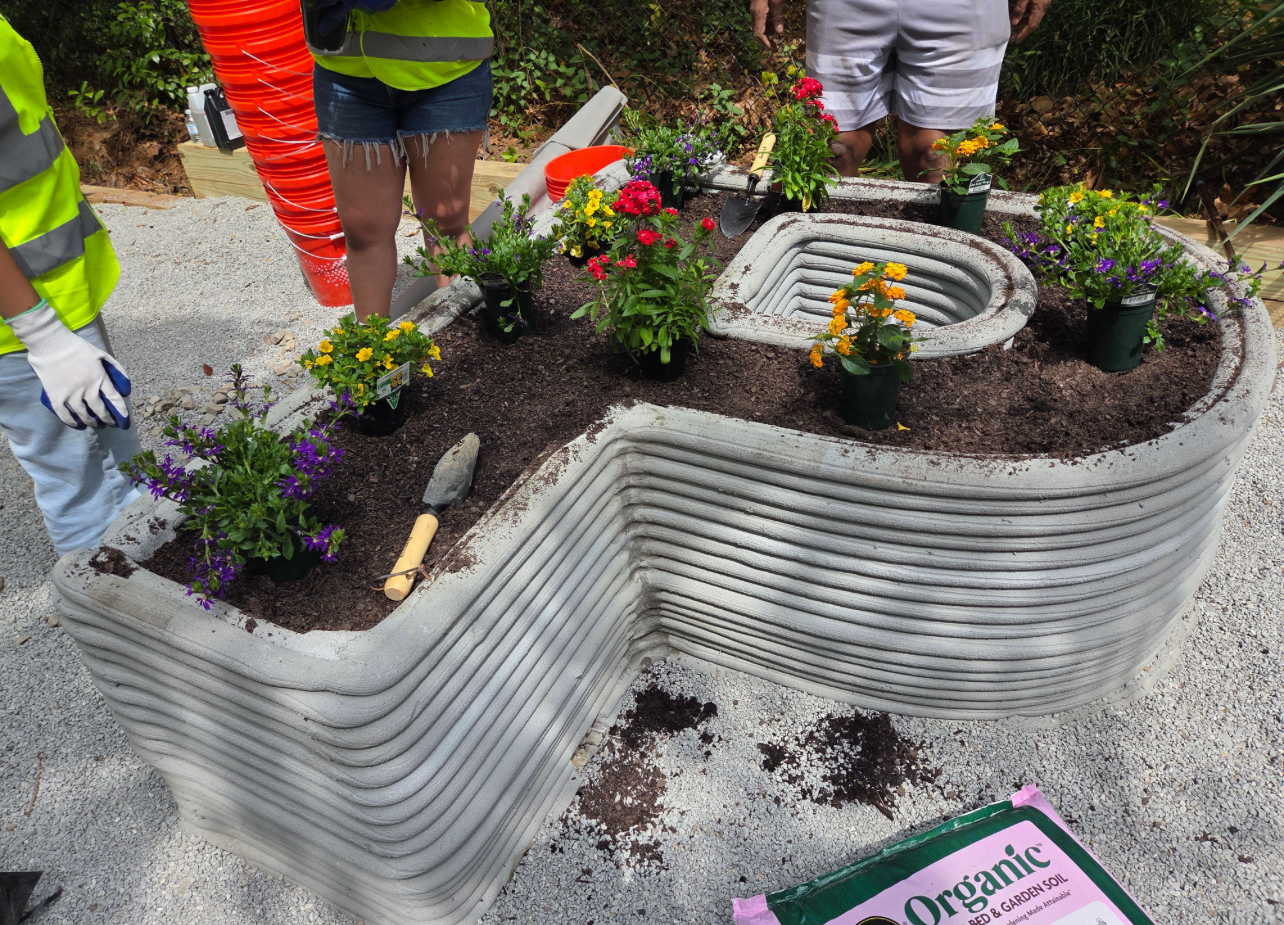

When the original wooden planters along PATH400 in Buckhead needed replacing, Livable Buckhead opted for more than a simple swap.
Instead, the organization partnered with QUIKRETE, Belter Tech, COBOD, and students from the University of Miami to create a striking, forward-looking solution: large-scale 3D-printed concrete raised beds.
3D-Printed Concrete Planters Along PATH400: What To Know
These new planters use approximately 70% less material than traditional cast-in-place concrete methods, are engineered for decades of durability, and creatively spell out “P-A-T-H-4-0-0” along the popular trail.
A Community Garden with Deep Roots
Volunteers filled the frames with plants during Earth Week on Friday, April 24, marking a visible upgrade to a beloved community space.
The garden has been a fixture along PATH400 since 2017.
For the past nine years, residents of the nearby Marian Road high-rise have lovingly maintained the raised beds, growing vegetables and flowers that add color and life to the greenway while fostering a strong sense of connection to their outdoor community.
The seniors will continue stewarding the upgraded planter beds.
“PATH400 has always been about bringing people together, and these new planters are a perfect reflection of that spirit,” said Denise Starling, executive director of Livable Buckhead. “We are proud to see innovation and community stewardship come together in such a visible way.”
Cutting-Edge Construction Meets Community Benefit
The project highlights the potential of emerging construction technologies when paired with thoughtful collaboration.
Originally planned to require about 20 cubic yards of concrete using conventional methods, the team shifted to 3D concrete printing, slashing material usage to roughly six cubic yards. The approach also eliminated the need for traditional footings, slab placement, and reinforcing steel.
What would have taken an estimated two weeks was compressed into just three to four days of installation.
QUIKRETE supplied the specialized 3D-printing concrete mix and managed logistics, including trucking from Atlanta to the University of Miami campus and back.
Belter Tech contributed key material innovations, such as lightweight synthetic foamed glass aggregate, which improves drainage and enhances long-term durability.
“It’s a great demonstration of innovative collaborations with community-based non-profits, academia and corporations,” said Gerald Hughes, founder and CEO of Belter Tech. “There was a lot of effort from all parties to make this happen, and it’s exciting to see it come to life.”
Real-World Impact for Students and the Public
For the University of Miami students involved in the design, the PATH400 planters represent far more than a classroom exercise.
Their work has become a permanent, public installation that thousands of trail users will see and interact with every day.
“This is a very exciting project that highlights how academia and industry can work together for community benefit,” said Dr. Prannoy Suraneni of the University of Miami.
The installation not only refreshes a community asset but also serves as a living showcase of sustainable construction.
By dramatically reducing material use, shortening timelines, and creating durable, low-maintenance structures, the 3D-printed planters demonstrate how innovative technologies can deliver both environmental and social value in urban spaces.
As PATH400 continues to grow as a vital 5.2-mile greenway connecting neighborhoods across Buckhead, these eye-catching, letter-shaped planters stand as a testament to what’s possible when community vision, corporate expertise, and academic creativity converge. The garden remains a place where residents grow more than just plants — they cultivate connections that strengthen the entire neighborhood.