-
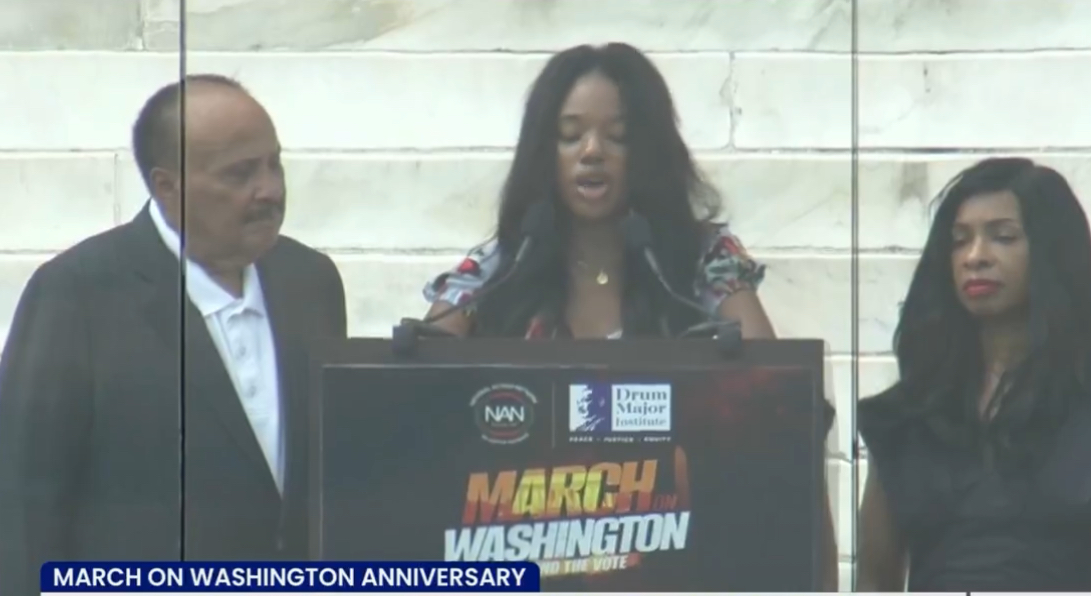
Yolanda Renee King, the only grandchild of Martin Luther King Jr. and Coretta Scott King, used the 63rd anniversary of the March on Washington to reject tired stereotypes about her generation and issue a challenge instead.
Speaking on August 28, 2026, the 18-year-old activist told the crowd that Gen Z is not apathetic. It is overwhelmed by how much it cares.
“I think my generation cares so much that sometimes we don’t know what to do with all of it,” she said. “The question is whether we will turn that caring into courage, whether we will turn our anxiety into action.”
Yolanda Renee King: ‘Don’t Tell Me My Generation Doesn’t Care’
The line landed as both diagnosis and assignment. King framed her generation’s political moment not as a failure of interest but as a test of conversion: from feeling to doing.
Who She Is
Born May 25, 2008, in Atlanta to Martin Luther King III and Arndrea Waters King, Yolanda Renee King never met her grandparents. She has spent most of her life in their shadow and, increasingly, in her own light. She first spoke nationally at age 9 at the 2018 March for Our Lives rally, invoking her grandfather’s dream while calling for an end to gun violence.
She has since written a children’s book, We Dream a World, spoken at the United Nations, protested for voting rights outside the White House, and helped launch the family’s Realize the Dream service initiative. She recently graduated from Atlanta International School and is headed to Columbia University.
Her 2026 March on Washington remarks continued a consistent theme: the dream was never finished, and remembrance is not enough. “You were asking us to continue,” she said of her grandfather. “So we will. We will pick up the baton. We will restore the dream.”
The Stereotypes She Refused
King listed the familiar complaints about Gen Z: distracted, glued to phones, short attention spans, too sensitive, cynical, uncaring. She rejected them outright.
Her generation, she argued, has grown up watching school shootings in real time and practicing active-shooter drills before they could spell “democracy.” They lived through a pandemic. They watched George Floyd call out for his mother. They have seen wars and suffering unfold on the screens they carry in their pockets. They inherited a planet in crisis, watched hatred amplified by algorithms, and seen rights previous generations fought to secure come under attack.
“So don’t tell me my generation doesn’t care,” she said. “We care.”
The overflow of feeling is the point. Constant exposure to crisis can produce paralysis as easily as passion. King’s question is whether that intensity becomes organizing.
From Caring to Courage
She stacked the conversions she wants her peers to make: caring into courage, anxiety into action, outrage into organizing, posts into purpose, followers into fellow citizens, a generation into a movement. “Get set because we have work to do,” she said.
The work she named was specific: protect the right to vote; refuse to treat gun violence as normal; confront racism, antisemitism, sexism, homophobia, xenophobia, Islamophobia, “and every ideology that tries to convince us that some human beings matter more than others.”
The speech echoed earlier remarks. At 12 she told a 2020 march that her generation would be defined by action, not apathy. At 14 she wrote that she did not want to walk into school afraid. The 2026 address was the same voice, older, more fluent in the gap between digital witnessing and civic power.
Why the Message Resonates
Gen Z did not invent political anxiety. It inherited a media environment that makes every atrocity immediate and a political system that often feels unresponsive. King did not romanticize that condition. She named it as the raw material of a movement—if her generation chooses to use it.
Her family history supplies both inspiration and warning. Martin Luther King Jr. was 34 when he delivered “I Have a Dream” and 39 when he was assassinated. Freedom, her grandmother Coretta Scott King often said, is never really won; it is earned in every generation. Yolanda has repeated that line for years. The 2026 speech was her generation’s reply: we know the work is unfinished, and we are here.
The test she posed is not whether young people feel enough. It is whether they will organize the feeling—whether anxiety becomes action, and caring becomes courage.