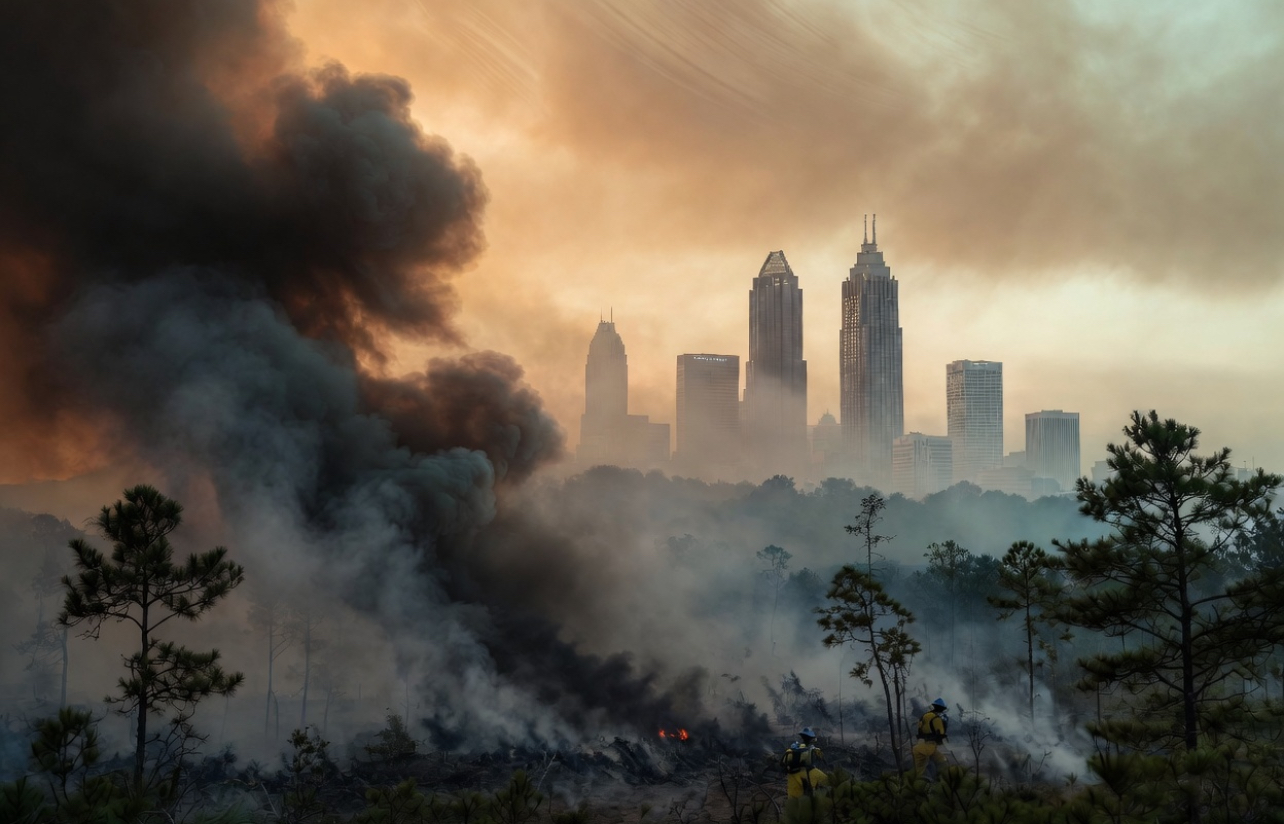

If you stepped outside in metro Atlanta on Wednesday, April 22, 2026, you likely noticed it: a strange haze blanketing the skyline, a faint but unmistakable smell of burning wood hanging in the air, and reduced visibility even on what should have been a clear spring day.
The culprit isn’t local pollution or fog—it’s smoke drifting hundreds of miles north from raging wildfires in south Georgia.
Is There Smoke in Atlanta Today?
Georgia is in the grip of severe drought, with more than 98% of the state under moderate to exceptional drought conditions.
Dry vegetation, low humidity, and windy weather have turned the region into a tinderbox. In just three days, nearly 100 fires ignited across south Georgia.
The largest and most destructive is the Clinch County Fire (also known as the Pineland Road Fire) near the Okefenokee Swamp, roughly 10 miles north of the Georgia-Florida line. As of April 22, it had scorched more than 16,000 acres and was only about 10% contained.
The Fires Burning in South Georgia
Additional fires in the area have burned thousands more acres, forcing evacuations, school closures, and road shutdowns in affected counties.
Governor Brian Kemp declared a state of emergency for more than 90 counties in south Georgia, mobilizing the Georgia Forestry Commission and emergency responders.
Similar blazes in northern Florida’s Big Bend region are also contributing to the regional smoke plume.
How Smoke Travels Hundreds of Miles to Atlanta
Wildfire smoke doesn’t stay put. Fine particles (PM2.5) and gases rise into the atmosphere and get carried by prevailing winds. In this case, a high-pressure system over the western Atlantic is driving southeasterly winds at lower levels, creating a “conveyor belt” that slowly pushes smoke northward.
Upper-level winds move west to east, helping spread the plume across the region. Southwest winds have limited the worst of the influx into metro Atlanta, but enough smoke has still arrived to create visible haze and that telltale burning odor.
The smoke has reached as far as Hartsfield-Jackson Atlanta International Airport, where it has reduced visibility for travelers. Conditions are even more pronounced in middle and south Georgia.YLbrV“LARGE”
Meteorologists expect hazy, smoky skies to persist through at least Friday, April 25.
A better chance for relief arrives Saturday when scattered rain is forecast to help wash the smoke out of the air and dampen fire danger—though the Clinch County Fire will likely continue burning until more significant rainfall or containment efforts succeed.
Air Quality and Health Concerns
Wildfire smoke contains a mix of fine particulate matter, carbon monoxide, and toxic chemicals that can irritate the eyes, nose, throat, and lungs. Even moderate levels can trigger coughing, wheezing, shortness of breath, and headaches.
People in sensitive groups—children, older adults, pregnant individuals, and those with asthma, COPD, heart disease, diabetes, or chronic conditions—are at higher risk.
Metro Atlanta is currently under Code Yellow (moderate) air quality conditions, with some pockets reaching unhealthy levels for sensitive groups.
Air quality is significantly worse closer to the fires. Check real-time conditions at AirNow.gov or local forecasts before heading outdoors.
Safety Tips: Protecting Yourself and Your Family from Smoke Inhalation
Here’s how to stay safe while the smoke lingers:
- Stay indoors as much as possible. Keep windows and doors tightly closed. If you have central air or heat, set it to “recirculate” mode and change or clean filters regularly to avoid pulling in outdoor smoke.
- Create a “clean room.” Pick one room in your home (ideally a bedroom), close it off from the rest of the house, and run a portable air cleaner or a DIY box-fan filter (MERV 13 or higher). Run it on high when you’re in the room. Never leave a box-fan filter unattended.
- Limit outdoor activity. Avoid strenuous exercise, yard work, or prolonged time outside when it looks or smells smoky. If you must go out, shorten your time and take frequent breaks indoors.
- Wear proper protection. If you have to be outside, use a NIOSH-approved N95 or P100 respirator that fits snugly against your face. Cloth masks, surgical masks, or bandanas do not provide adequate protection against fine smoke particles.
- Monitor symptoms. Watch for coughing, wheezing, chest tightness, or irritated eyes. Have rescue inhalers or medications ready if you have respiratory conditions. Seek medical help if symptoms worsen.
- Protect vulnerable groups and pets. Children and pets should stay inside. Keep pets indoors and provide fresh water. Consider bringing sensitive family members to a community building or public space with better air filtration if your home becomes too smoky.
- Avoid adding to indoor pollution. Don’t burn candles, use gas stoves, or smoke tobacco indoors. Vacuum with a HEPA filter if needed, but skip sweeping or dusting that could stir up particles.
These steps come straight from CDC and EPA guidance for wildfire smoke events and can dramatically reduce your exposure.
Looking Ahead
Firefighters continue battling the flames under challenging drought conditions, while state officials urge residents in fire-prone areas to heed burn bans and evacuation orders.
For the rest of us in metro Atlanta, the haze is an unwelcome reminder of how interconnected our region’s air really is.
Stay informed via local news, the Georgia Forestry Commission, or AirNow.gov. With rain on the horizon, clearer skies—and safer breathing—should return soon. In the meantime, take simple precautions and look out for neighbors who may need extra help.
More from AtlantaFi.com: