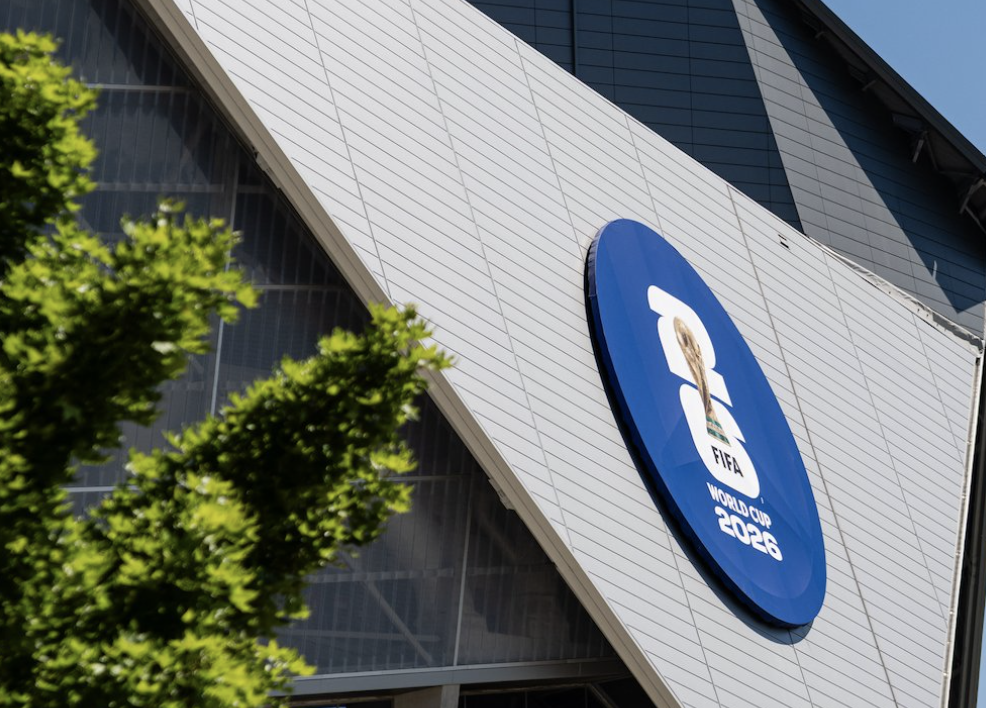

As the 2026 FIFA World Cup draws closer, one of America’s most iconic venues is undergoing a major transformation to comply with the tournament’s strict branding rules.
Mercedes-Benz Stadium in Atlanta—home to the NFL’s Atlanta Falcons and MLS’s Atlanta United—will officially be known as “Atlanta Stadium” during the event.
Mercedes-Benz Stadium Prepares for FIFA World Cup 2026: Temporarily Renamed ‘Atlanta Stadium’
At the same time, workers have begun covering up corporate logos throughout the $1.6 billion facility to meet FIFA’s “clean zone” requirements.
FIFA’s policy is straightforward and long-standing: host venues must eliminate all pre-existing commercial branding, advertising, and sponsorship signage that isn’t tied to official World Cup partners. The goal is to protect FIFA’s own sponsors and prevent “ambush marketing” by non-partners.
This applies to everything from concourse signs and scoreboards to seat backs and even rooftop logos visible from the air or in aerial broadcasts.
The rule has created logistical headaches for several NFL stadiums hosting World Cup matches, but Atlanta’s case stands out.
Stadium officials estimate they will need to cover or remove roughly 2,000 branded elements inside and around the venue.
Crews have already started the work, draping large FIFA World Cup 2026 banners over prominent Mercedes-Benz star logos on the building’s exterior.
The temporary name change is part of a broader pattern across U.S. host venues. Other NFL stadiums are also dropping their corporate titles for the tournament—AT&T Stadium becomes “Dallas Stadium,” for example—to avoid any conflict with FIFA’s sponsorship program.
Mercedes-Benz holds naming rights to the Atlanta venue through 2042 under a $324 million deal signed in 2015, but that agreement takes a back seat for the duration of the World Cup.
The Roof That Broke the Rules (Sort Of)
One element of the stadium’s famous branding proved impossible to hide without major risk. The massive three-pointed Mercedes-Benz star integrated into the center of the eight-panel retractable roof could not be safely covered.
The roof’s panels are made of a flexible, air-inflated plastic material; any attempt to apply vinyl wraps or other coverings risked structural damage that could cost millions to repair.
After roughly 18 months of negotiations, FIFA granted Atlanta a unique exemption—the only one among the 16 World Cup venues. The roof logo will remain visible when the roof is closed (as it is expected to be for most matches).
When the roof is open, the star disappears from view anyway. Stadium leaders have said they do not plan to open it during World Cup games, minimizing any visibility issues.
Why the Strict Rules?
FIFA’s brand-protection strategy is designed to safeguard the billions of dollars in sponsorship revenue tied to the World Cup. The policy extends beyond the stadium footprint to surrounding “clean zones,” where unauthorized advertising is also banned.
Similar requirements have been in place for previous tournaments, but the 2026 edition—co-hosted by the United States, Canada, and Mexico—marks the first time so many heavily branded NFL venues are involved.
For Atlanta, the changes represent both a challenge and an opportunity. The city will host multiple group-stage matches, a Round of 32 game, and a quarterfinal at the stadium (capacity around 71,000 for soccer).
Local organizers are handling the bulk of the rebranding costs and logistics, underscoring how global events still rely on host-city infrastructure and investment.
While some fans may miss seeing the familiar “Benz” branding during the tournament, the transformation underscores the World Cup’s massive commercial scale.
By the time the first whistle blows in Atlanta in summer 2026, the stadium will look every bit the neutral, FIFA-approved stage—roof logo notwithstanding.