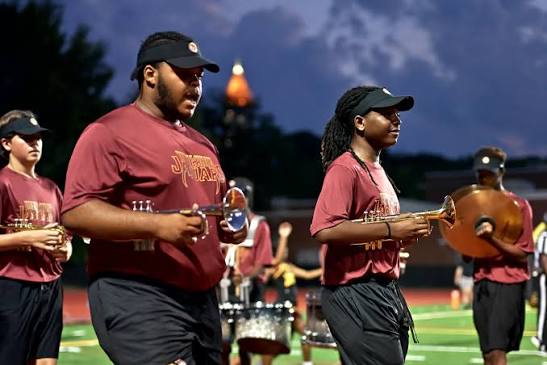

Atlanta Public Schools issued a public statement Monday after reports that members of the Maynard Jackson High School marching band were subjected to racist language following a football game at Jefferson High School.
The district said it is “deeply concerned” by the accounts. No students were physically harmed, according to APS, but officials said they take the allegations seriously and are working with Jefferson High School administrators to investigate. Additional counseling is being offered at Maynard Jackson beginning Monday, September 14, and students can also use the district’s Talk It Out platform.
The statement followed a Friday night, September 11, 2026, non-region game in Jefferson, Georgia. Jefferson’s Dragons defeated the visiting Jaguars 30-0. Maynard Jackson students, including the football team and marching band, had traveled roughly 60 miles northeast of Atlanta for the contest.
Allegations of racial slurs, Confederate flags being displayed
APS has confirmed receiving reports that racist language was directed at band members as they left the stadium and loaded buses. Jefferson City Schools said it is aware of concerns circulating on social media, is reviewing them, and has contacted Maynard Jackson officials. Neither district has announced disciplinary action.
Social media posts and emails to local media have alleged a wider pattern of incidents during the game: racial slurs, Confederate flags being displayed or waved, football players being spit on after tackles, and food being spit on band members near the concession stand. Some accounts claimed Maynard Jackson coaches advised students not to use restrooms or walk the stadium alone. FOX 5 Atlanta, which reported the story, said it has not independently confirmed those additional claims.
A Tale of 2 Schools
Maynard H. Jackson High School is an Atlanta Public Schools campus in the Grant Park area of southeast Atlanta. It is named for Maynard Holbrook Jackson Jr., Atlanta’s first Black mayor, who served from 1974 to 1982 and again from 1990 to 1994. The school enrolls about 1,550 students.
Recent demographic data show a student body that is roughly 70 percent Black, 18 percent White, and 8–9 percent Hispanic, with about half of students classified as economically disadvantaged.
Jefferson High School is the sole high school in the Jefferson City School District in Jackson County. The town of Jefferson sits in a more rural and suburban setting. The school enrolls roughly 1,300 students and is about 75 percent White, 10 percent Black, and 9–11 percent Hispanic, with a lower share of students classified as economically disadvantaged than Maynard Jackson.
Jefferson has a strong football tradition and has made deep playoff runs in recent years. The two programs have met before, including in the 2023 Class 5A playoffs, when Jefferson won 48-14.
The pairing is typical of Georgia high school football: a large urban district traveling to a smaller city for a non-conference game. Friday night football remains a major social event in many Georgia communities, drawing large crowds of students, families, and local residents.
Troubling Developments Feed into Southern Tropes
Incidents involving racial slurs, taunting, or symbols at high school sporting events surface periodically in Georgia and across the South. They often involve visiting teams from majority-Black urban schools and host crowds from majority-White smaller towns or suburbs. Schools and athletic associations generally treat such behavior as a violation of sportsmanship codes, but investigations can be complicated when the conduct occurs among spectators rather than players or when evidence is limited to social media videos and secondhand reports.
In this case both districts have said they are gathering information. APS emphasized support for affected students and families. Jefferson City Schools described the reports as concerns it takes seriously. As of Monday evening, the story remained in the early investigation stage, with no public identification of specific individuals or a completed set of findings.
High school athletics and marching band programs are among the most visible extracurricular activities in Georgia. When they become the setting for racial hostility, the impact extends beyond a single game: students who traveled as representatives of their school return home describing an experience that felt unsafe or degrading. Districts now face the dual task of determining what occurred and deciding what, if any, consequences or policy changes follow.
Here are more articles from AtlantaFi.com: