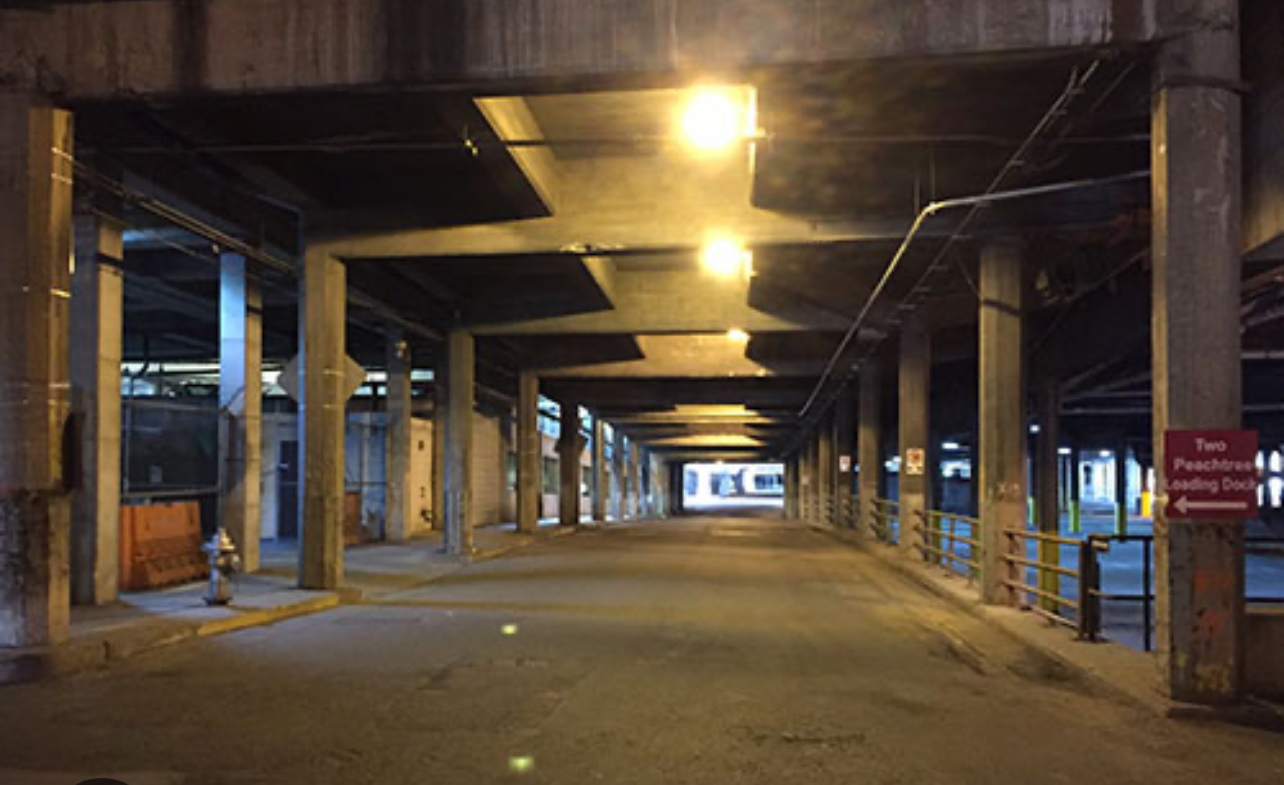

Kim Williams braved the chilly air one morning to walk underneath a parking lot connecting to swaths of downtown Atlanta.
An avid runner from Savannah, Williams says she was fascinated by the infrastructure underneath the parking lot, leading her to believe there used to be much more.
”I was just struck by how well developed the spaces were under this old, dingy parking lot,” the 33-year-old architect said. “That’s when I realized this used to be something, like, there’s an underground city here.
Williams is right on the money. Remnants of that city have most recently been called “Underground Atlanta.”
Underground Atlanta: What It Was and Is Now
For most people, Underground Atlanta conjures up memories of shopping at Sam Goody’s record store, eating at the food court or listening to live music at Kenny’s Alley or Dante’s Down the Hatch. Those heydays of the 1980s and 1990s are long gone.

Despite recent efforts to revitalize the area, Underground Atlanta is largely a ghost town right now compared to how it was.
“So many huge development proposals struggle: Newport’s for South Downtown, WRS’s for Underground Atlanta, Microsoft’s at Bankhead, the Midtown interstate cap, the previous plans for West End Mall & Civic Center that fizzled…and now Murphy Crossing,” said Darin Givens, cofounder of ThreadATL and urbanism advocate, pointing to Underground Atlanta as an example of stalled projects amid Atlanta’s construction and growth challenges.
Underground Atlanta’s Past

Underground Atlanta contains remnants of original 1920s street-level storefronts and sidewalks, sealed off when Atlanta raised its streets with viaducts to combat traffic and railroad congestion, creating a “city beneath the streets” that was later rediscovered and revitalized as a unique district.
The city elevated streets like Pryor and Alabama, effectively burying the original ground level, which became forgotten for decades before being reimagined as a nightlife spot in the late 1960s.
Key Details:
- The Project: The “twin viaducts” project in the late 1920s (around 1927-1929) raised major downtown streets by one to one-and-a-half stories.
- The Result: The original street level, with its businesses and sidewalks, was covered over, becoming basements and tunnels.
- The “Underground”: Merchants moved upstairs, and the lower levels became storage, service areas, and even speakeasies during Prohibition.
- Abandonment: For about 40 years, this area was largely forgotten until its rediscovery and revival as Underground Atlanta starting in the late 1960s.
What Was Atlanta’s ‘Twin Viaducts’ Project?
In the late 1920s, as Atlanta boomed into a major Southern hub, its downtown core faced a growing crisis: deadly and chaotic railroad crossings.
With multiple major rail lines converging in the heart of the city—creating constant gridlock for pedestrians, streetcars, automobiles, and freight trains—city leaders turned to an ambitious solution. The result was the so-called “twin viaducts” project, a major infrastructure initiative constructed between 1927 and 1929 that dramatically reshaped downtown Atlanta and gave birth to what we now know as Underground Atlanta.
The Purpose: Solving Railroad Congestion in a Growing City
Atlanta’s identity as a railroad terminus dates back to its founding in the 1830s, but by the early 20th century, the rapid rise of automobiles and urban population made at-grade rail crossings increasingly dangerous and inefficient.
Pedestrians and vehicles risked their lives daily at intersections near Union Station (the main depot at the time), where trains frequently blocked streets like Pryor and Central Avenue.
The twin viaducts project aimed to separate traffic levels entirely. By elevating key streets above the rail lines, the city could create a seamless grid for modern transportation while keeping trains moving below.
This was part of a broader wave of viaduct construction in Atlanta during the 1920s, driven by the Chamber of Commerce and city engineers to accommodate the automobile era without halting rail commerce.
What the Project Entailed
The “twin viaducts” specifically referred to the parallel elevated structures built along Pryor Street and Central Avenue (running north-south), connected by raised “laterals” on Alabama Street and Wall Street (running east-west). Completed around 1928–1929, these reinforced concrete viaducts raised the street level by approximately one to one-and-a-half stories (about 15–20 feet in places).
- Construction involved massive excavation to lower rail tracks for clearance, upgrades to utilities (sewers, gas mains, electric cabling), and the building of sturdy concrete spans with Neoclassical detailing.
- A five-block area around the historic commercial district near Union Station was effectively “covered over,” entombing the original ground-level streets, brick-paved sidewalks, and 19th-century storefronts beneath the new elevated plane.
- Merchants adapted quickly: many relocated their shops to the second floor (now the new street level), turning the original ground floors into basements for storage, service areas—and, during Prohibition, even speakeasies and hidden juke joints.
The project was hailed as a triumph of engineering, alleviating congestion in the commercial heart of downtown and creating a multi-level cityscape that still defines Atlanta today.

The Lasting Legacy: From Forgotten Streets to Underground Atlanta
While the viaducts solved immediate traffic woes, they had an unintended consequence: the burial of an entire historic street level.
For decades, the original 1860s–1870s storefronts, cobblestone alleys (like Kenny’s Alley and Ponder’s Alley), and gas-lit sidewalks lay abandoned and largely forgotten below.
It wasn’t until the late 1960s that this “city beneath the streets” was rediscovered and revitalized as Underground Atlanta, transforming the subterranean space into a vibrant nightlife and entertainment district with preserved Victorian-era architecture, bars, shops, and cultural venues.
Today, as projects like Centennial Yards continue to build over Atlanta’s historic rail gulch, the twin viaducts remain a powerful symbol of the city’s resilience and ingenuity.
They remind us how Atlanta has repeatedly elevated itself—literally—to overcome growth challenges, turning potential obstacles into unique urban features that blend past and present.
In a city built on rails, the twin viaducts of 1927–1929 proved that sometimes the best way forward is to build upward… and leave a fascinating layer of history below.