-
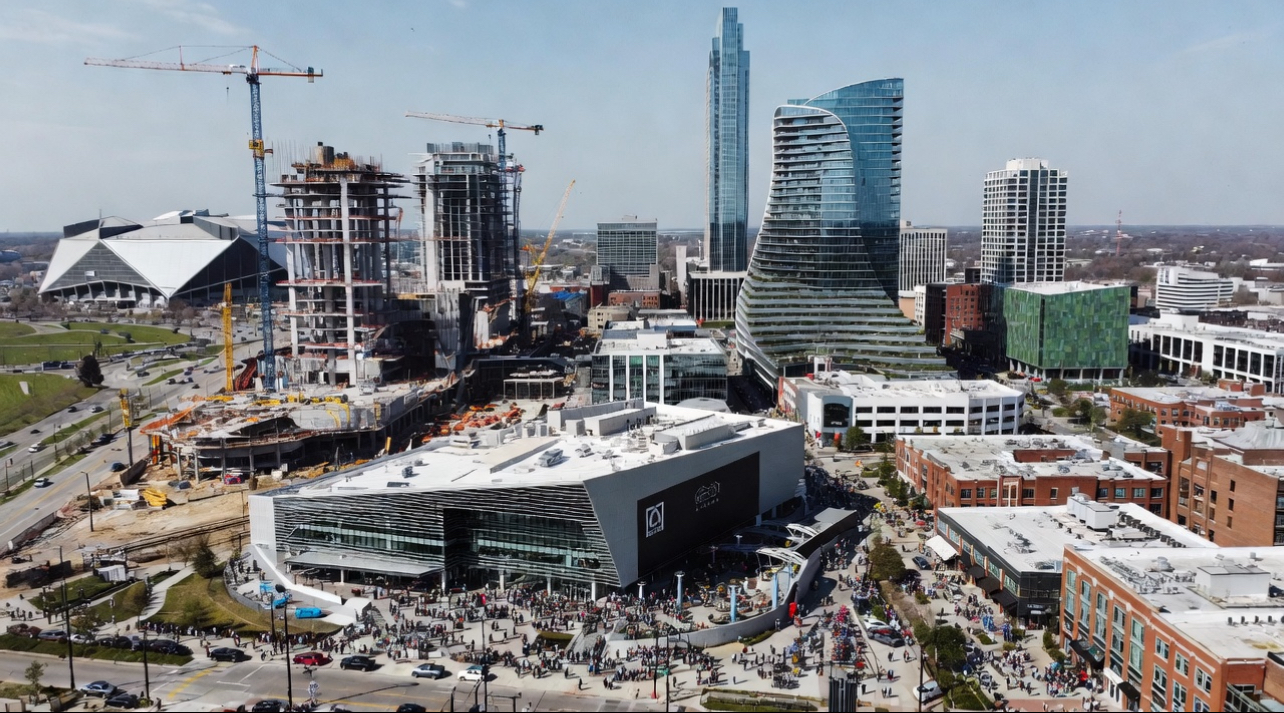
Downtown Atlanta is undergoing one of its most ambitious transformations in decades with Centennial Yards, a $5 billion mixed-use development rising from the long-dormant Gulch area adjacent to Centennial Olympic Park.
Once a sprawling network of railyards that fueled the city’s early growth, this 50-acre site—often called “the hole” in the heart of the city—is being reimagined as a vibrant district blending residential, commercial, entertainment, and hospitality spaces.
Centennial Yards Aims To Revitalize Atlanta’s Downtown Gulch
“If you want big, shiny and new, you come to Centennial Yards,” Brian McGowan, President of Centennial Yards, said in promotional material.
As Atlanta prepares to host eight matches of the FIFA World Cup 2026 at Mercedes-Benz Stadium, Centennial Yards is poised to become a central hub for locals and visitors alike, bridging the gap between the city’s historic core and its modern aspirations.
A Historical Foundation: From Railyards to Redevelopment
The story of Centennial Yards begins with Atlanta’s origins as a railroad terminus in the 19th century. The Gulch, located between Five Points MARTA station and Mercedes-Benz Stadium, served as a key hub for the Western & Atlantic Railway, earning the site the nickname “Mile 0.”

For much of the 20th century, it bustled with freight and passenger activity, but by the late 1900s, it had fallen into disuse, becoming a vast expanse of parking lots and underutilized land plagued by infrastructure challenges like active train tracks and elevation differences.
Efforts to redevelop the Gulch gained momentum in the 2010s, culminating in a landmark 2018 agreement between the City of Atlanta and Los Angeles-based developer CIM Group.
The Atlanta City Council approved a public financing package that included up to $1.9 billion in tax incentives, allowing the developer to tap into future sales and property tax revenues generated on-site to fund construction.
This deal, one of the largest in the city’s history, aimed to overcome the site’s complexities and spur economic growth. Groundbreaking occurred in 2024, marking the start of a multi-phase project expected to span until 2030.
The project’s name pays homage to nearby Centennial Olympic Park, built for the 1996 Summer Olympics, and reflects a vision to extend that legacy of urban renewal.
CIM Group, in partnership with the City of Atlanta and private investors, leads the development through Centennial Yards Company.
The Centennial Yards Project Today: A Mixed-Use Metropolis
At its core, Centennial Yards is designed to create a “city within a city,” adding several new blocks to downtown Atlanta.

The 50-acre development will feature over 4 million square feet of office space, more than 1,000 hotel rooms, around 1,000 residential units, and extensive retail, dining, and entertainment options.
Key components include:- Residential Spaces: Thousands of new apartments, starting with a 304-unit complex in the first phase. These aim to attract a diverse mix of residents, fostering an inclusive community with direct access to MARTA and nearby attractions.
- Hospitality: Two hotels are already underway, including the 292-key Hotel Phoenix, which opened in late 2025 and sets a new standard for luxury with rooftop views, a pool deck, and dining at Zephyr. A 14-story boutique hotel in the Entertainment District topped out in January 2026, with another four-story hotel progressing along Ellis Street.
- Entertainment District: This 8-acre, 470,000-square-foot centerpiece, designed by firms Gensler and SHAPE, anchors the project. It includes a 5,300-capacity music venue operated by Live Nation (leased in May 2025), a Cosm immersive technology experience set to open in 2026, a two-story food and beverage hall, and an expansive fan zone. The district balances high-rises with terraced green spaces, paying homage to Atlanta’s “City in the Forest” moniker, and all new buildings will be LEED-certified for energy efficiency.
- Retail and Dining: A growing roster of tenants highlights Atlanta’s cultural flair. Recent announcements include iconic soul food spot The Busy Bee opening a third location in 2027 with a fast-service format and full bar; Shake Shack’s 3,010-square-foot outpost; The Irish Exit, a modern Irish pub from the Dead Rabbit team, slated for summer 2026; and upscale steakhouse Chops Lobster Bar, set for late 2026. These join plans for 95,000 square feet of retail, emphasizing local and immersive “eatertainment” concepts.
The vision extends beyond buildings: public plazas, green terraces, and event spaces like the Steele Bridge for tailgates and pre-parties tie into nearby venues such as State Farm Arena and Mercedes-Benz Stadium, creating the Southeast’s largest sports and entertainment district.
Construction Updates: Rising Ahead of Schedule
As of early early 2026, construction is advancing rapidly. Cranes dominate the skyline, with the Entertainment District’s third-tallest structure—a cornerstone hotel—topping out in January.
Secondary buildings, including the Live Nation venue and Cosm, are taking shape, with the latter on track for a debut later this year.
The project has already restricted Gulch parking to focus on vertical development, and recent drone footage, shows significant progress across the site.
When Will Centennial Park Be Completed?
The developer aims to have two-thirds of the project ready for the 2026 FIFA World Cup, including entertainment venues and apartments, with further phases continuing beyond.
This pace aligns with Atlanta’s FIFA World Cup preparations, ensuring the Entertainment District serves as a culinary and social hub for the June matches.
The overall completion of this $5 billion development is expected to extend well past 2026, with some office components currently paused.
Economic and Community Impact: A Catalyst for Growth
Proponents hail Centennial Yards as a game-changer for downtown Atlanta, which has long lacked a true urban core. The project is projected to generate thousands of jobs, attract businesses, and boost tourism, especially with the World Cup drawing global attention.
By reconnecting east and west Atlanta, it addresses underutilized land and enhances walkability with MARTA integration.
Local residents and business owners express optimism. “Centennial Yards is clearly going to change that,” said one developer in reference to downtown’s past stagnation.
Events like SEC Championship tailgates and Peach Bowl pre-parties already activate the space, fostering community ties.
Economically, the $5 billion investment, supported by $557 million in bonds for the Entertainment District, is seen as a masterclass in urban revitalization.
Challenges and Criticisms: Tax Breaks and Housing Concerns
Not all views are rosy. The project’s tax incentives have sparked controversy, with critics arguing the $1.9 billion package represents an unnecessary giveaway to a profitable developer.
A 2025 report from the Private Equity Stakeholder Project highlighted ongoing debates over public subsidies. Legal challenges, including a case that reached the Georgia Supreme Court in 2020, questioned the deal’s structure.
Affordable housing is another flashpoint. Despite commitments to make 20% of units affordable, Centennial Yards opted out for its first apartment tower, paying $8 million in in-lieu fees—about $132,000 per unit—instead of providing 61 affordable apartments.
Alison Johnson, Executive Director of Housing Justice League, has been vocal about her dismay.
“As housing continues to become more and more unaffordable across the city, disappointment does not begin to describe how we feel about the recent decision to not provide any affordable units in the [new residential] development at Centennial Yards,” Johnson said.
Critics note these fees, based on outdated 2017 data, fall short of actual construction costs, shortchanging the city’s housing trust fund.
The in-lieu fee of about $132,000 per declined affordable unit “was probably too low… even when the contract was initially signed [in 2018],” said Dan Immergluck, Georgia State University urban studies professor. “Now… an appropriate per-unit in-lieu fee is probably over $400,000 per unit — maybe more.”
Additionally, there’s no plan for a multi-modal passenger rail terminal, missing an opportunity to enhance transit despite the site’s rail heritage.
Looking Ahead: A New Era for Atlanta
As Centennial Yards continues to rise—block by block, crane by crane—it promises to deliver the downtown Atlanta deserves: inclusive, energetic, and world-class.
With phases rolling out through 2030, the project could redefine the city’s urban landscape, much like the 1996 Olympics did.
For now, as the World Cup approaches, all eyes are on this transformative endeavor, balancing bold ambition with the need to address community concerns. AtlantaFi.com will continue monitoring developments as this mega-project unfolds.