

The reminders of Margaret Munnerlyn Mitchell are all around Atlanta, including the author’s longtime home in Midtown.
Her lasting testament was one solitary novel, “Gone With the Wind,” a Civil War-era masterpiece which won the title of Most Distinguished Novel in 1936 and a Pulitzer Prize the following year.
Mitchell, who was born in 1900 and died in 1949, was shaped by much of what she learned in “The ’60s” — the 1860s. That’s what the old-timers of her day often told her about when she listened to their stories. Civil War veterans waxed on about a poetic South where the white man’s enchanted existence was seen as unstoppable.
When recalling her mother, Mitchell once said, “She talked about the world those people had lived in, such a secure world, and how it had exploded beneath them. And she told me that my world was going to explode under me, someday, and God help me if I didn’t have some weapon to meet the new world.”
From her older relatives who remembered the genuine, slaveholding Old South, this is what she said: “On Sunday afternoons when we went calling on the older generation of relatives, those who had been active in the Sixties, I sat on the bony knees of veterans and the fat slippery laps of great aunts and heard them talk.”
Margaret Mitchell, the Atlanta-born author whose 1936 novel Gone with the Wind captured the world’s imagination, had complex and multifaceted connections to Black women throughout her life.
While her book has long been critiqued for its romanticized portrayal of the antebellum South and enslaved people—including the iconic character of Mammy—the historical record reveals a more nuanced side to Mitchell’s personal relationships and actions in her hometown.
In her personal life, Mitchell formed close, long-term bonds with Black women who worked in her household.
For many years, she employed loyal housekeepers and domestic workers such as Carrie Holbrook and Bessie Berry Jordan. These women were not mere employees; Mitchell treated them with notable care and affection. In her will, she left a house specifically to one of her longtime servants as a bequest, ensuring their security after her death in 1949.
Letters and accounts show Mitchell’s compassion toward these women, reflecting personal loyalty that transcended the employer-employee dynamic common in mid-20th-century Atlanta.
One of the most documented ties was Mitchell’s correspondence and friendship with Hattie McDaniel, the groundbreaking actress who portrayed Mammy in the 1939 film adaptation.
When McDaniel won the Academy Award for Best Supporting Actress—the first Black performer to win an Oscar—she and Mitchell exchanged warm letters. McDaniel praised the “authenticity” of Mitchell’s depiction of Southern life, drawing from stories her own grandmother had shared.
Mitchell, in turn, expressed admiration for McDaniel’s performance and regret over the segregation that barred Black cast members, including McDaniel, from attending the film’s glittering premiere in Atlanta.
Their exchange grew into a lifelong pen-pal relationship built on mutual respect, despite the racial divides of the era.
Beyond personal connections, Mitchell quietly supported Black Atlantans in ways that were extraordinary for a white woman of her time and social standing.
Deeply troubled by the inadequate healthcare available to African Americans in segregated Atlanta, she became one of the most significant anonymous benefactors of Morehouse College, the historically Black institution. Working discreetly with Morehouse president Benjamin Mays (a key civil rights figure and mentor to Martin Luther King Jr.), Mitchell funneled substantial funds—drawn from her Gone with the Wind royalties—to provide scholarships for Black medical students.
This support helped train nearly 50 physicians who might otherwise have been unable to complete their education, addressing the dire shortage of Black doctors serving their communities. Recipients like Dr. Otis Smith later credited her generosity with enabling their careers, noting that Mitchell insisted on anonymity to avoid controversy in a segregated society.
These efforts highlight a quieter, progressive aspect of Mitchell’s legacy—one often overshadowed by debates over her novel’s racial portrayals.
In an era when cross-racial friendships and philanthropy were rare and fraught, Mitchell reached across divides in private ways that benefited Black women and families in Atlanta for generations.
Margaret Mitchell’s Death
As a literary superstar Mitchell was second to none in Atlanta. So it made quite a commotion when in August 1949, she died at Grady Hospital of injuries received when she was struck down by a speeding caron Peachtree Street in downtown Atlanta.
The driver, a 29-year-old taxi driver, was charged with drunken driving, speeding and driving on the wrong side of the street.
Gov. Herman Talmadge ordered the flag over the State Capitol lowered to half-staff until after the funeral.
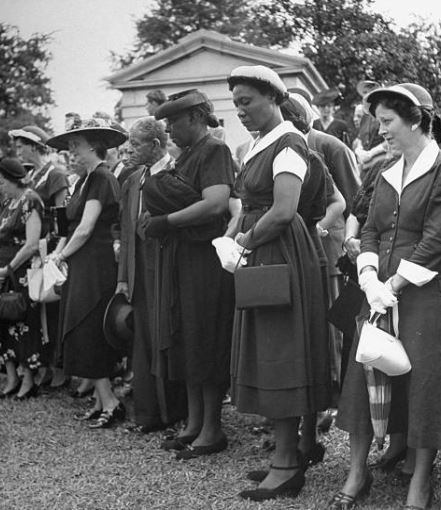
Crowds of people swelled to pay respects at a funeral service at Spring Hill, Atlanta funeral home. Today, she rests entombed at the historic Oakland Cemetery on the city’s east side.
Years later, it was disclosed that Mitchell secretly donated funds to educate young black men.
“We have in our archives, our collection, the bank books, the checks,” says college archivist Herman “Skip” Mason.
“Dr. Martin Luther King in his ‘I have a Dream’ speech talked about, ‘One day, I’d like to have a nation where the sons of former slaves will be able to sit down at the table of brotherhood with the sons of former slave-owners,'” Atlanta historian Ira Joe Johnson was quoted as saying. “And I say, at Morehouse, twenty years before Dr. King gave that speech, Margaret Mitchell not only sat down at the table, she pulled out the check.”
As our city continues to reflect on its literary icons, Margaret Mitchell’s story reminds us that history is rarely one-dimensional.
Her ties to Black women encompassed household loyalty, artistic collaboration, and behind-the-scenes advocacy—threads that wove her into the fabric of Atlanta’s complex racial story.
As you can see, Atlanta’s history is rich when it comes to African-American excellence. Along with having many cool things to do in Atlanta, the city offers a great history lesson of the progress of U.S. society. If you want to support black businesses in Atlanta in a material way, here are some resources to help you.