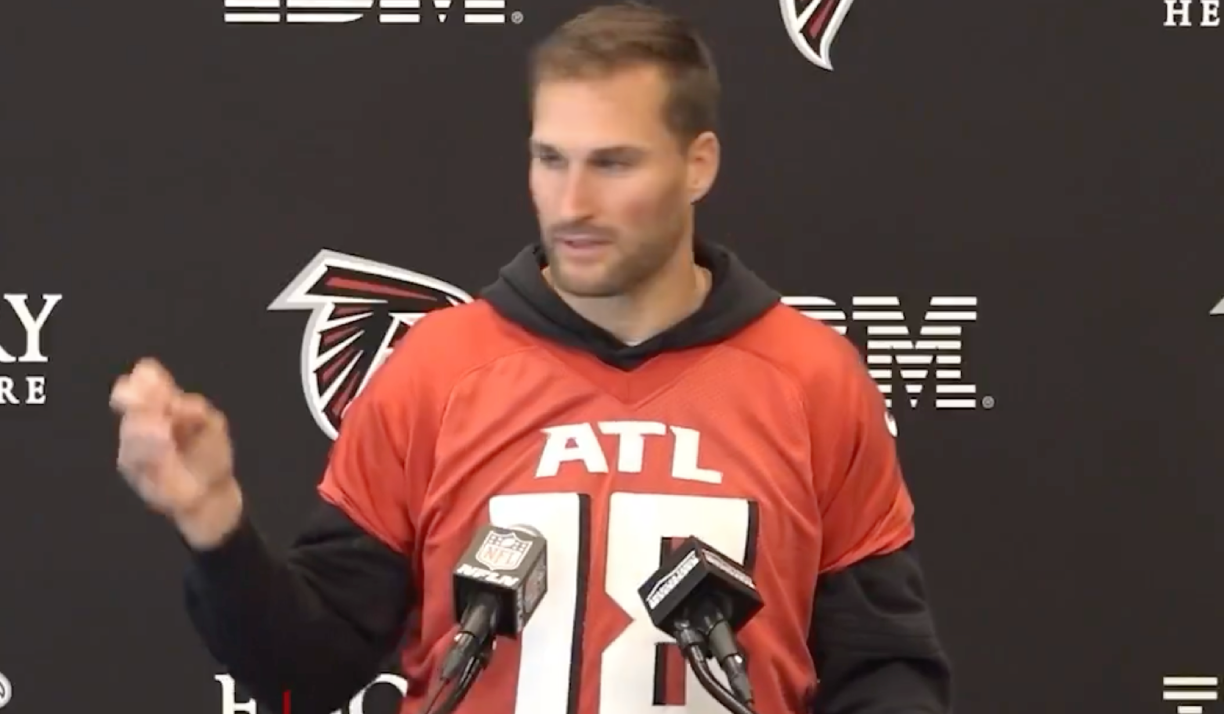

Atlanta Falcons quarterback Kirk Cousins has spent the last decade evading sacks and throwing touchdowns, so it shouldn’t be a shock when he talks technique on the gridiron, but that’s exactly what he did recently after a Falcons practice session in Flowery Branch.
Cousins, speaking to the media as he awaits the Falcons next game, answered a simple question but in essence he gave a State of the Quarterback address when talking about how signal callers read defenses today.
Falcons’ QB Kirk Cousins On How To Beat a Defense
In his spiel, he spilled the beans on exactly why defenses have been winning the chess match lately. When a reporter asked him about the ongoing debate on “progression reads” (sequentially checking receivers 1 through 5) and “coverage reads” (diagnosing defensive alignments pre-snap to eliminate portions of the field), the 37-year-old veteran eagerly jumped in:
“I’d love to get into it… I can get on this soapbox if you want me to, because I lived the transition,” he said.
Cousins, who entered the league in 2012, described the old-school approach that dominated when he was coming up: Quarterbacks would quickly identify whether the safety alignment was single-high or split-safety pre-snap, then “cut the field in half” and focus on just 2-3 eligible receivers.
Alerts for pressure or specific coverages kept things simple. “But what happened,” Cousins explained, “is defenses have gotten so good at disguising it.”
Coordinators now routinely show one look before the snap—often a safe two-high shell—only to rotate into single-high coverage, man, or blitz after the ball is snapped. This post-snap deception leaves quarterbacks unable to trust their pre-snap diagnosis, forcing hesitation during the critical early stages of the dropback.

Image: Cover 2 defense
The result? Offenses have largely abandoned complex pre-snap processing in favor of “pure progressions”—rigid sequencing where the QB must methodically work through receivers regardless of the coverage.
Cousins recalled his time under current Rams head coach Kevin O’Connell in Minnesota, when reintroducing more pure progressions felt overwhelming at first: “I remember when KOC was bringing a lot of pure progression reads back… it was like whoa, that’s a lot.”
While pure progressions reduce weekly preparation stress—no more game plans hinging on perfect safety reads—they come at a cost. “If you truly try to go 1-2-3-4-5, you’re gonna get sacked,” Cousins warned, noting that elite pass rushes force quicker decisions or checkdowns.
This shift, Cousins implied, is a major reason why gaudy individual passing stats have become rarer in recent years. The era of routine 5,000-yard, 40-touchdown seasons has cooled, as quarterbacks hold the ball longer on average, inviting more pressure and disruption.
League-wide trends in 2025 reflect this: While top passers like Dak Prescott lead in yards, explosive aerial attacks are less consistent, with defenses dictating tempo through disguise and rotation.
Cousins’ breakdown resonates across the league, echoing comments from coordinators like the Vikings’ Wes Phillips, who has noted the explosion of coverage variations—inversions, reduced fronts, and post-snap rotations—that make pre-snap certainty nearly impossible.
For a quarterback like Cousins, who has adapted through multiple systems and is currently thriving in relief of the injured Michael Penix Jr.—including a recent 373-yard, three-touchdown performance—it’s a testament to survival in an ever-evolving chess match.
Final Word
As defenses continue to innovate, the pure progression era may be here to stay, keeping pass rushes smiling and stat sheets a bit more grounded.