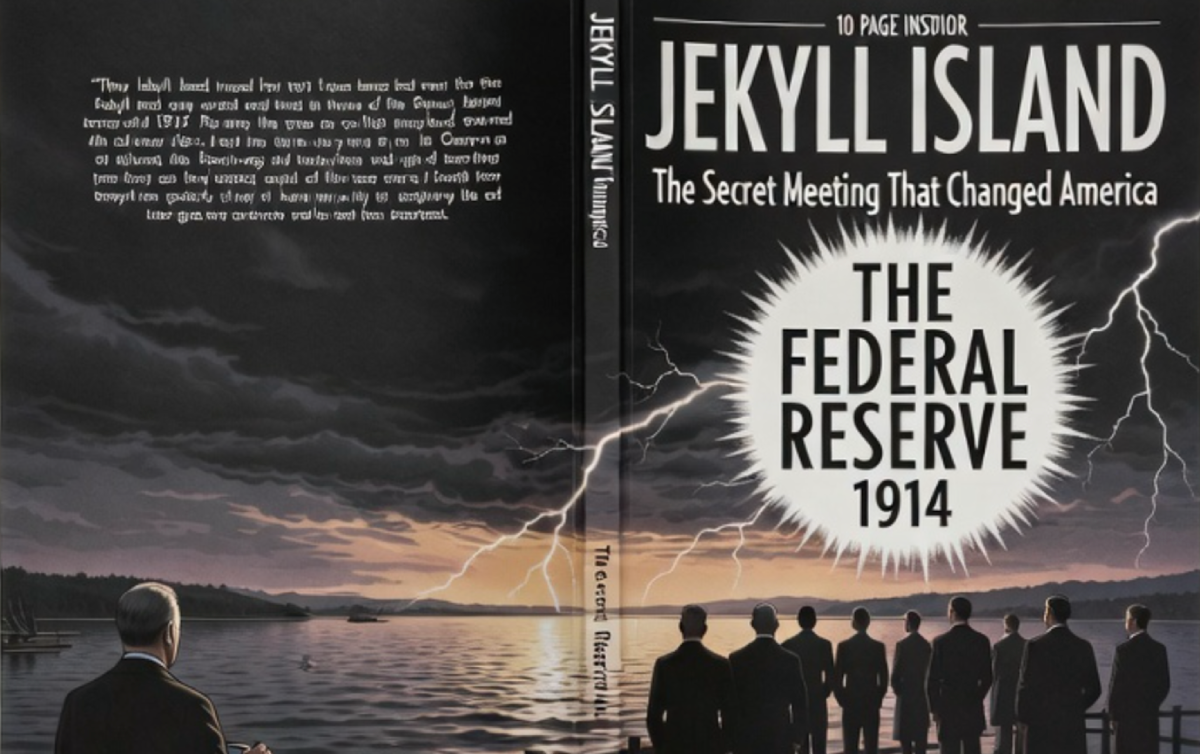

In the annals of American financial history, few institutions loom as large—or as controversial—as the Federal Reserve System. Often simply called “the Fed,” this central banking powerhouse was born not in the marble halls of Washington, D.C., but amid the misty shores of Georgia’s Jekyll Island.
As Atlantans, we take a certain local pride in this pivotal chapter, even as it raises uncomfortable questions about secrecy, power, and economic control.
This article delves into the turbulent conditions that preceded the Fed’s creation, the shadowy origins right here in our state, and the far-reaching ramifications that continue to shape our economy today.
The Precarious Financial Landscape Before the Fed
To understand why the Federal Reserve was deemed necessary, we must rewind to the late 19th and early 20th centuries, a time when America’s banking system was a patchwork of instability.
Without a central bank, the U.S. relied on a decentralized network of national and state banks, backed by the gold standard but plagued by frequent panics and runs on deposits.
America on the Brink: A Nation Held Hostage by Bank Panics
Before 1913, America’s money system was a ticking time bomb. Bank runs weren’t rare – they were routine. One rumor, one bad harvest, one Wall Street gamble gone wrong, and entire towns watched their life savings vanish overnight.The Panic of 1907 was the final straw.
Stock market crashed 50%. Banks boarded up their doors. Grown men fought in the streets to withdraw cash that no longer existed. The entire system teetered on the edge of total collapse.
The message was clear: the United States of America had no control over its own money.
The Panic of 1907 — the first global financial crisis of the 19th century — stands out as the catalyst. Triggered by a failed speculative bid to corner the market on United Copper Company stock, it led to widespread bank failures, stock market crashes, and economic turmoil.
“The immediate trigger of the panic was a failed effort by a group of speculators to corner the stock of the United Copper Company,” former Fed Chairman Ben Bernanke said in a speech on the subject. “The main perpetrators of the failed scheme, F. Augustus Heinze and C.F. Morse, had extensive connections with a number of leading financial institutions in New York City. When the news of the failed speculation broke, depositor fears about the health of those institutions led to a series of runs on banks, including a bank at which Heinze served as president.”
In New York, trust companies—unregulated entities similar to banks—faced massive withdrawals, forcing closures and sparking contagion across the country. J.P. Morgan, the era’s most powerful financier, personally intervened by pooling funds from wealthy bankers to bail out failing institutions, averting total collapse.
But this ad-hoc rescue highlighted a glaring vulnerability: the U.S. had no formal mechanism to provide liquidity during crises, no lender of last resort.
Prior panics in 1873, 1893, and others had exposed similar flaws.
Currency was inelastic, meaning it couldn’t expand or contract with economic needs—farmers in the agrarian South, including Georgia, often suffered from tight money supplies during harvest seasons, leading to deflation and debt burdens.
Regional disparities were stark; Southern banks, still recovering from the Civil War, were particularly underserved. Calls for reform grew louder, with populists like William Jennings Bryan advocating for “free silver” to inflate the currency, while bankers pushed for a more stable, centralized system.
By 1910, the stage was set for change. The Aldrich-Vreeland Act of 1908 provided temporary emergency currency, but it was a stopgap. Influential figures, including Senator Nelson Aldrich of Rhode Island—chairman of the National Monetary Commission—recognized the need for a permanent solution. Yet, public distrust of “money trusts” and big banks made open reform politically risky.

The Secret Birth on Jekyll Island
Enter Georgia’s Jekyll Island, a secluded barrier island off the coast near Brunswick, once a winter retreat for America’s elite like the Rockefellers and Vanderbilts. In November 1910, under the cover of a fabricated “duck hunting trip,” a group of six powerful men convened at the Jekyll Island Club to draft what would become the blueprint for the Federal Reserve.

Led by Senator Aldrich, the attendees included Paul Warburg (a German-born banker from Kuhn, Loeb & Co.), Frank Vanderlip (president of National City Bank), Henry Davison (a J.P. Morgan partner), Charles Norton (president of First National Bank of New York), and Benjamin Strong (another Morgan associate). Abraham Piatt Andrew, assistant secretary of the Treasury, rounded out the group.
They arrived incognito, using first names only to avoid detection, as any whiff of a “bankers’ conspiracy” could derail their efforts. Over 10 days, they hammered out the “Aldrich Plan,” proposing a central bank controlled by private bankers with regional branches to manage currency and credit.

This was no altruistic endeavor; the men represented institutions holding about one-fourth of the world’s wealth. Their goal: Stabilize banking while preserving private influence, countering populist demands for government control.
The plan faced opposition. Progressives like Congressman Charles Lindbergh Sr. decried it as a “money trust” scheme. After revisions to appease Democrats—renaming it the Federal Reserve Act, adding presidential appointments, and creating 12 regional banks—it passed Congress in 1913.
President Woodrow Wilson signed it on December 23, 1913, and the system became operational in 1914, with Atlanta hosting one of the regional Federal Reserve Banks (District 6), a nod to Southern economic needs.
Why Georgia? Jekyll Island’s isolation ensured secrecy, allowing frank discussions away from prying eyes. As Warburg later wrote, “The results of the conference were entirely confidential. Even the fact that there had been a meeting was not permitted to become public.” This Georgia genesis underscores how Southern geography inadvertently cradled a national transformation.
Ramifications: Stability, Power, and Enduring Controversies
The Federal Reserve’s creation marked a seismic shift. Initially, it achieved its core aims: providing elastic currency through open market operations, discount lending, and reserve requirements. The Fed helped finance World War I by buying government bonds, stabilizing the economy during the 1920s boom.
Post-1929 Crash, however, its tight money policies exacerbated the Great Depression, leading to reforms like the Banking Act of 1935, which centralized power in the Board of Governors.
Long-term effects have been profound. The Fed’s dual mandate—maximizing employment and stabilizing prices—has guided monetary policy through crises like the 2008 financial meltdown and the COVID-19 pandemic, where it injected trillions in liquidity.
Economically, it ended recurrent panics, fostered growth, and enabled fiat currency after Nixon’s 1971 gold standard abandonment. Atlanta’s Fed branch, for instance, oversees payments and research for the Southeast, contributing to regional stability.
Yet, ramifications include sharp criticisms. Detractors argue the Fed enables inflation—eroding purchasing power since 1913, with the dollar losing over 96% of its value. Conspiracy theories abound, from G. Edward Griffin’s The Creature from Jekyll Island portraying it as a cartel enriching elites, to claims it perpetuates debt-based money.
Since that secret Georgia meeting:
- The dollar has lost 97% of its purchasing power. A 1913 dollar is worth less than 3 cents today.
- The Fed has financed every major war – and every major bubble – of the last 100 years.
- It has the unchecked power to print trillions out of thin air, making the rich richer while your paycheck buys less every year.
- It operates in near-total secrecy. Even Congress is forbidden from auditing its most critical decisions.
Politically, it has fueled debates over independence; Presidents like Trump have pressured it for lower rates, while audits (like Ron Paul’s “Audit the Fed” push) seek transparency.
In Georgia, the Fed’s legacy is tangible. Our state’s economy, from agriculture to fintech hubs in Atlanta, benefits from stable credit, but rural areas still grapple with unequal access.
Final Word
As we mark over a century since that fateful meeting, the Fed remains a double-edged sword: a guardian against chaos or an unchecked behemoth?
This unflinching look reminds us that history’s turning points often hide in plain sight—or, in this case, behind Georgia’s coastal dunes. For better or worse, the Federal Reserve’s roots run deep in our soil, influencing every dollar we earn and spend.
More From AtlantaFi.com: