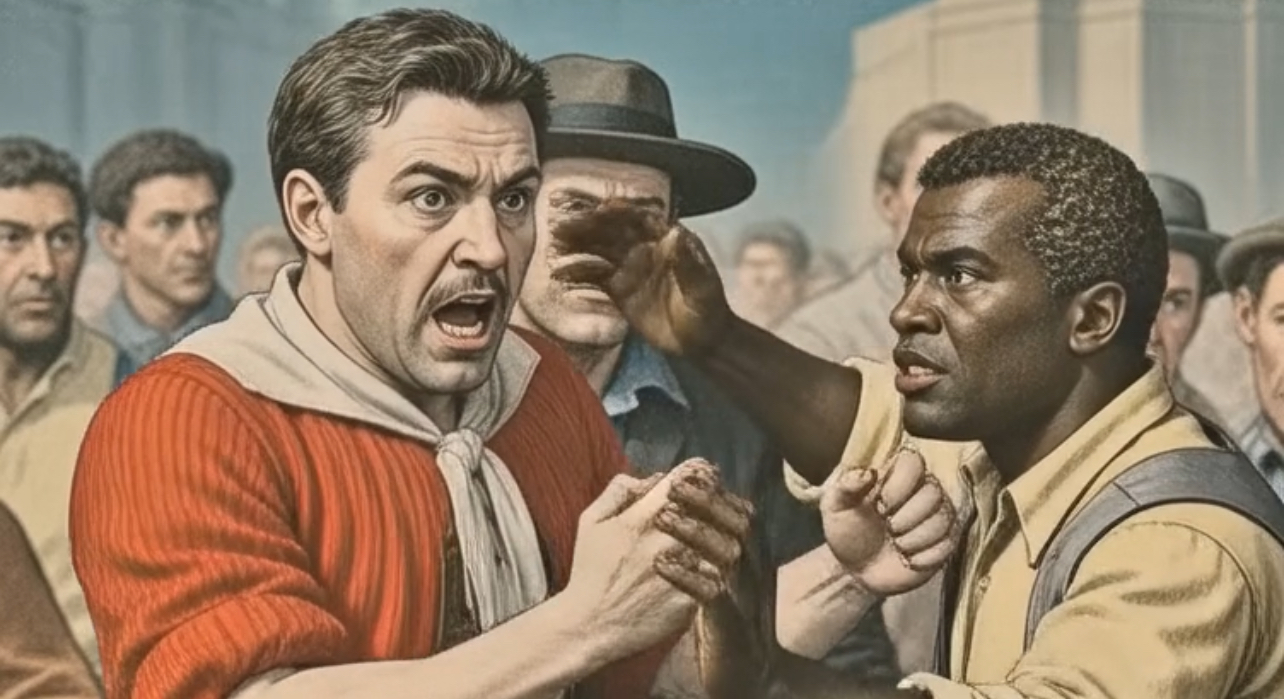

The “Atlanta Race Riots”—more accurately termed the Atlanta Race Massacre—occurred from September 22 to 26, 1906, and stand as a brutal manifestation of the lingering wounds of a divided America.
Relatively few people realize that America’s freedoms are not birthright privileges, but rather hard-fought pacts forged from strife — and war, America’s civil war.
The Confederacy’s defeat in 1865 unleashed a torrent of unresolved racial animosities that festered through Reconstruction and into the Jim Crow South.
What Were the Atlanta Race Riots?
The riots were not a spontaneous clash but a targeted pogrom by white mobs against Atlanta’s Black community, resulting in at least 25 confirmed Black deaths (with estimates up to 100), over 100 injuries, and widespread destruction of Black-owned property.
In his 1948 memoir A Man Called White, civil rights activist and NAACP executive director Walter White recounts his personal experience as a 13-year-old during the riot, defending his home alongside his father.
He describes the mob’s approach: “There was a crash as Negroes smashed the street lamp at the corner of Houston and Piedmont Avenue down the street. In a very few minutes the vanguard of the mob, some of them bearing torches, appeared. A voice which we recognized as that of the son of the grocer with whom we had traded for many years yelled, ‘That’s where that nigger mail carrier lives! Let’s burn it down! It’s too nice for a nigger to live in!'”
It exemplified the South’s descent into institutionalized white supremacy, where the emancipatory promises of the Union victory were systematically dismantled.
Immediate Triggers: Sensationalism and Election-Year Politics
The spark ignited on September 22, 1906, when Atlanta’s white-owned newspapers—the Atlanta Journal, Atlanta Constitution, Atlanta Georgian, and Atlanta News—published lurid, unverified stories alleging that four white women had been sexually assaulted by Black men over the previous weekend.
Yellow Journalism
These reports, rife with racial stereotypes portraying Black men as predatory threats to white womanhood, were amplified by the era’s yellow journalism.
One particularly inflammatory account described the brutal beating of 16-year-old Mabel Lawrence and her aunt, which left Mabel hospitalized and blinded in one eye.
Such stories were not isolated; they echoed a broader pattern of fabricated “outrages” used to justify violence across the South.
This media frenzy about black violence fueled by yellow journalism coincided with Georgia’s heated 1906 gubernatorial election between Democrat Hoke Smith and Clark Howell.

Both candidates, owners of competing newspapers (Journal for Smith, Constitution for Howell), vied for white supremacist votes by promising to disenfranchise Black Georgians.
Smith explicitly campaigned on barring Black voters from the polls, framing them as a criminal underclass unfit for citizenship.
Historian Mark Bauerlein in his 2001 book Negrophobia: A Race Riot in Atlanta, 1906, traces the buildup: “Riots don’t occur spontaneously—they take time to build up, sometimes years. You have years of social tensions, community conflicts, and political manipulations.”
Cultural provocations, like the touring stage production of Thomas Dixon Jr.’s The Clansman (which romanticized the Ku Klux Klan and inspired the later film The Birth of a Nation), further inflamed white audiences in Atlanta theaters.

Underlying Causes: Economic Competition and Racial Resentment
Beneath the headlines lay deeper fissures rooted in Atlanta’s explosive growth and the South’s uneven recovery from the Civil War.
Atlanta, rebuilt as a railroad hub after General Sherman’s 1864 March to the Sea devastated it, ballooned from 89,000 residents in 1900 to over 150,000 by 1910, with the Black population surging from 9,000 in 1880 to 35,000 in 1900.
This urbanization drew rural Black migrants seeking factory jobs in cotton mills, railroads, and emerging industries, but whites viewed them as threats to their economic dominance.
Black entrepreneurs, like barber Alonzo Herndon (who built a fortune serving white clients), symbolized unwelcome Black advancement, fostering resentment over jobs, housing, and political influence.

Public spaces became flashpoints: Streetcars, operated by the Georgia Railway and Power Company, were sites of enforced segregation, where Black riders faced harassment and violence for perceived violations of racial etiquette.
Black saloons on Decatur Street, hubs of community life, were demonized as dens of vice, despite whites frequenting similar establishments.
These tensions reflected a zero-sum worldview: As Blacks gained ground post-emancipation, whites clung to supremacy through violence.
The Broader Conditions of the South in 1906
By 1906, the South was a powder keg of poverty, segregation, and terror, scarred by the Civil War’s legacy and Reconstruction’s betrayal.
The Confederacy’s collapse had freed 4 million enslaved people, but federal troops’ withdrawal in 1877 ushered in the “Redemption” era, where white Democrats reclaimed power through fraud, intimidation, and paramilitary groups like the KKK.
Jim Crow laws—codified segregation in schools, trains, restaurants, and beyond—solidified by the 1890s Supreme Court ruling in Plessy v. Ferguson (1896), turned the region into an apartheid state.
Economically, the South languished in agrarian stagnation. Sharecropping trapped most Black (and many poor white) families in cycles of debt peonage, where cotton yields barely covered advances from white landowners, yielding per capita incomes half those of the North.
Industrialization in cities like Atlanta created jobs but exacerbated racial divides: Whites monopolized skilled trades and government posts (e.g., Atlanta’s police and fire departments were all-white), while Blacks were relegated to menial labor.
Literacy rates among Southern Blacks hovered around 50%, hampered by underfunded segregated schools, compared to near-universal white education.
Politically, Black disenfranchisement was rampant. Georgia’s 1877 constitution imposed poll taxes and residency requirements, but as the 1906 election showed, whites pushed for harsher measures like literacy tests and grandfather clauses (exempting illiterate whites whose grandfathers voted pre-1867).
Nationally, lynchings peaked in the 1890s–1900s, with over 3,000 documented between 1882 and 1968, often for alleged sexual crimes—mirroring Atlanta’s trigger.
The “Lost Cause” mythology romanticized the Confederacy as a noble defense of states’ rights (veiling slavery), justifying Black subjugation as natural order.
Governor Joseph Terrell, a Confederate veteran, embodied this: His National Guard quelled the riots but targeted Black self-defense groups, raiding Brownsville and arresting 250 residents, including educators from Clark University.
Socially, the South was a cauldron of fear and fatalism.
Journalist and author Ray Stannard Baker, in his 1908 book Following the Color Line, analyzes the riot’s causes and aftermath, noting the inflammatory role of media and politics: “Such a wave was the Atlanta riot. Its ominous size, greater by far than the ordinary race disturbances which express themselves in lynchings, alarmed the entire country.”
He quotes Atlanta lawyer Charles T. Hopkins on the economic fallout: “Atlanta’s credit was good for millions before the riot but unable to borrow 50 cents afterward.”
Baker also critiques the broader racial dynamics, observing streetcar segregation: “The very first time I was on a car in Atlanta, I saw the conductor—all conductors are white—ask a Negro woman to get up and take a seat farther back in order to make a place for a white man.”
White elites preached accommodation (à la Booker T. Washington), but events like Atlanta’s massacre radicalized Black leaders—W.E.B. Du Bois, teaching at Atlanta University, armed himself and later channeled outrage into The Crisis magazine.
After the Atlanta Race Riots, academic W.E.B. Du Bois bought a shotgun and said, “If a white mob would step on the campus where I lived, without hesitation I would put their guts on the grass.”

Du Bois, a professor at Atlanta University at the time, responded to the riot with his poem “A Litany of Atlanta,” published in The Independent on October 11, 1906.
In it, he laments the violence: “A city lay in travail, God our Lord, and from her loins sprang twin Murder and Black Hate. Red was the midnight; clang, crack and cry of death and fury filled the air and trembled underneath the stars when church spires pointed silently to Thee. And all this was to sate the greed of greedy men who hide behind the veil of vengeance!”
For whites, the riots reinforced complacency; Mayor James G. Woodward blamed Black “criminality,” ignoring mob savagery.
Aftermath and Legacy
The massacre ended with rain and militia intervention, but its scars endured. Hoke Smith won the governorship and enacted Black disenfranchisement in 1908, slashing Black voters from 30,000 to under 500 in Atlanta by 1910.
Black businesses relocated to enclaves like Sweet Auburn, birthing a vibrant middle class but under constant threat.
The event was whitewashed in local histories until its 2006 centennial commemoration, when Atlanta finally reckoned with this chapter of its past.
In the Southeast’s Confederate heartland, 1906 underscored a grim truth: The Civil War’s end birthed not equality but a redeployed war on Black freedom—one fought with ballots, bullets, and bylines.
It prefigured later atrocities like the 1919 Red Summer and Tulsa Massacre, reminding us how unhealed wounds ignite anew. For deeper reading, I recommend Gregory Mixon’s The Atlanta Riot or the New Georgia Encyclopedia’s entry.
More From AtlantaFi.com: